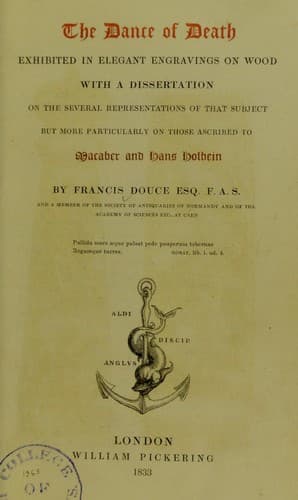
The Dance of Death: Exhibited in Elegant Engravings on Wood with a Dissertation on the Several Representations of that Subject but More Particularly on Those Ascribed to Macaber and Hans HolbeinDouce, Francis
History
The Dance of Death: Exhibited in Elegant Engravings on Wood with a Dissertation on the Several Representations of that Subject but More Particularly on Those Ascribed to Macaber and Hans Holbein
Douce, Francis
Bible. Old Testament -- Illustrations; Dance of death
Quid aureorum me beabit copia.
Amore si privata sim dulcissimo.
Its companion--Death with his hour-glass stands behind an old woman, who
offers money to a youth turning in disdain to his young mistress. At
bottom, these lines:
JUVENIS.
Facie esse quid mihi gratius posset tua
Ipsius haud Corinthi gaza divitis.
VETULA.
Formam quid ah miselle nudam respicis
Cum plus beare possit auri copia.
MORS.
At tu juventa quid torquêre frustra anus
Quin jam sepulchri instantis es potius memor.
Both oblong, 6 by 4.
An engraving by Bosse of a queen reposing on a tent bed, Death peeps in
through the curtains, another Death stands at the corner of the bed,
whilst a female with a shield, inscribed PIETAS, levels a dart at the
queen. Underneath, these verses:
Grand Dieu je suis donc le victime
Qu'une vengeance legitime
Doit immoler à tes autels
Je n'ay point de repos qui n'augmente ma peine
Et les tristes objets d'une face inhumaine
Me sont autant de coups mortels.
Oblong, 4-1/2 by 3.
An engraving by John Sadeler, after Stradanus, of an old couple, with
their children and grandchildren, in the kitchen of a farm-house. Death
enters, fantastically crowned with flowers and an hour-glass, and with a
bagpipe in his left hand. Round his right arm and body is a chain with a
hook at the extremity. He offers his right hand to the old woman, who on
her knees is imploring him for a little more delay. In the back-ground, a
man conducted to prison; beggars receiving alms, &c. At bottom, these
lines:
"Pauperibus mors grata venit; redimita corona
Florifera, et luctus ultima risus habet."
On the top of the print, "O mors bonum est judicium tuum homini indigenti,
et qui minoratur viribus defecto ætate, &c." Eccl. cap. xli. Oblong, 11 by
8-1/2.
An exceedingly clever etching by Tiepolo of a group of various persons, to
whom Death, sitting on the ground and habited grotesquely as an old woman,
is reading a lecture. Oblong, 7 by 5-1/2.
A small circle, engraved by Le Blond, of Death appearing to the
astrologer, copied from the same subject in the Lyons wood-cuts.
A print, painted and engraved by John Lyvijus of two card players
quarrelling. Death seizes and strikes at them with a bone. Below,
Rixas atque odia satagit dispergere serpens,
Antiquus, cuncta at jurgia morte cadunt.
Oblong, 10 by 7-1/2.
An engraving by Langlois. Death with a basket at his shoulder, on which
sits an owl, and holding with one hand a lantern, seizes the dice of a
gambler sitting at a table with his winnings spread before him. At top,
these verses:
Alarme O le pipeur, chassez, chassez le moy,
Je ne veux pas jouer a la raffle avec toy.
LA MORT.
A la raffle je joue avec toutes personnes
Toutes pieces je prends, tant meschantes que bonnes.
At bottom, a dialogue between the gambler and Death, in verse, beginning
"J'ay ramenè ma chance il n'y a plus reméde." Upright, 10 by 7-1/2.
Public-domain text, read in full here on John Shaqi.
Reviews
Reviews
No reviews yet
Be the first to share your thoughts on this work.
Elsewhere in the archive
Join the Discussion
Join the discussion
Sign in to leave a comment or review.
Sign InorCreate an account