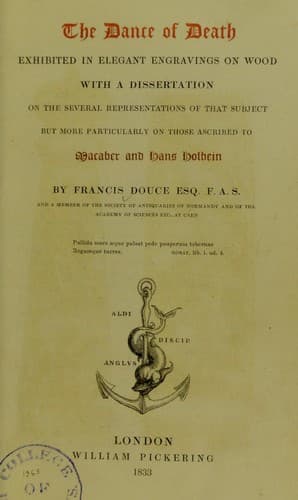
The Dance of Death: Exhibited in Elegant Engravings on Wood with a Dissertation on the Several Representations of that Subject but More Particularly on Those Ascribed to Macaber and Hans HolbeinDouce, Francis
History
The Dance of Death: Exhibited in Elegant Engravings on Wood with a Dissertation on the Several Representations of that Subject but More Particularly on Those Ascribed to Macaber and Hans Holbein
Douce, Francis
Bible. Old Testament -- Illustrations; Dance of death
Notwithstanding the interdiction in several councils against the practice
of dancing in churches and church-yards, it was found impossible to
abolish it altogether; and it therefore became necessary that something of
a similar, but more decorous, nature should be substituted, which, whilst
it afforded recreation and amusement, might, at the same time, convey with
it a moral and religious sensation. It is, therefore, extremely probable,
that, in furtherance of this intention, the clergy contrived and
introduced the Dance or Pageant of Death, or, as it was sometimes called,
the Dance of Macaber, for reasons that will hereafter appear. Mr. Warton
states, "that in many churches of France there was an ancient show, or
mimickry, in which all ranks of life were personated by the ecclesiastics,
who danced together, and disappeared one after another."[30] Again,
speaking of Lydgate's poem on this subject, he says, "these verses,
founded on a sort of spiritual masquerade antiently celebrated in
churches, &c."[31] M. Barante, in his History of the Dukes of Burgundy,
adverting to the entertainments that took place at Paris when Philip le
Bon visited that city in 1424, observes, "that these were not solely made
for the nobility, the common people being likewise amused from the month
of August to the following season of Lent with the Dance of Death in the
church yard of the Innocents, the English being particularly gratified
with this exhibition, which included all ranks and conditions of men,
Death being, morally, the principal character."[32] Another French
historian, M. de Villeneuve Bargemont, informs us that the Duke of Bedford
celebrated his victory at Verneuil by a festival in the centre of the
French capital. The rest of what this writer has recorded on the subject
before us will be best given in his own words, "Nous voulons parler de
cette fameuse _procession_ qu'on vit defiler dans les rues de Paris, sous
le nom de _danse Macabrée ou infernale_, epouvantable divertissement,
auquel présidoit un squelette ceint du diadême royal, tenant un sceptre
dans ses mains décharnées et assis sur un trône resplendissant d'or et de
pierreries. Ce spectacle repoussant, mêlange odieux de deuil et de joie,
inconnu jusqu'alors, et qui ne s'est jamais renouvellé, n'eut guere pour
témoins que des soldats étrangers, ou quelques malheureux échappés à tous
les fléaux réunis, et qui avoient vu descendre tous leurs parens, tous
leurs amis, dans ces sepulchres qu'on dépouilloit alors de leurs
ossemens."[33] A third French writer has also treated the Dance of Death
as a spectacle exhibited in like manner to the people of Paris.[34] M.
Peignot, to whom the reader is obliged for these historical notices in his
ingenious researches on the present subject, very plausibly conceives that
their authors have entirely mistaken the sense of an old chronicle or
journal under Charles VI. and VII. which he quotes in the following
words.--"Item.
Public-domain text, read in full here on John Shaqi.
Reviews
Reviews
No reviews yet
Be the first to share your thoughts on this work.
Join the Discussion
Join the discussion
Sign in to leave a comment or review.
Sign InorCreate an account