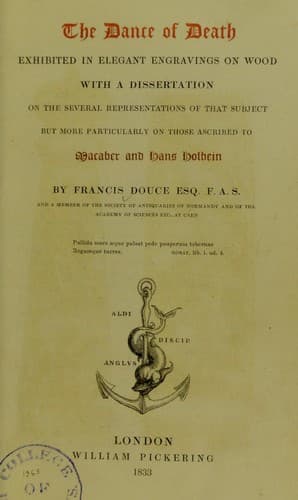
The Dance of Death: Exhibited in Elegant Engravings on Wood with a Dissertation on the Several Representations of that Subject but More Particularly on Those Ascribed to Macaber and Hans HolbeinDouce, Francis
History
The Dance of Death: Exhibited in Elegant Engravings on Wood with a Dissertation on the Several Representations of that Subject but More Particularly on Those Ascribed to Macaber and Hans Holbein
Douce, Francis
Bible. Old Testament -- Illustrations; Dance of death
Mr. Dagley, in the second edition of his "Death's Doings," p. 7, has
noticed some very masterly designs chalked on a wall bordering the road
from Turnham-Green towards Kew-Bridge. They exhibited figures of Death as
a skeleton ludicrously occupied with gamblers, dancers, boxers, &c. all
of the natural size. They were unfortunately swept away before any copies
were made to perpetuate them, as they well deserved. It was stated in The
Times newspaper that these sketches were made by a nephew of Mr. Baron
Garrow, then living in retirement near the spot, but who afterwards
obtained a situation in India. These drawings were made in 1819.
Four very clever coloured drawings by Rowlandson, being probably a portion
of an unfinished series of a Death's Dance. 1. The Suicide. A man seated
near a table is in the act of discharging a pistol at his head. The sudden
and terrific appearance of Death, who, starting from behind a curtain,
significantly stares at him through an eye-glass. One of the candles is
thrown down, and a wine-glass jerked out of the hand of the suicide, who,
from a broken sword and a hat with a cockade, seems intended for some
ruined soldier of fashion. A female servant, alarmed at the report of the
pistol, rushes into the apartment. Below, these verses:
Death smiles, and seems his dart to hide,
When he beholds the suicide.
2. The Good Man, Death, and the Doctor. A young clergyman reads prayers to
the dying man; the females of his family are shedding tears. Death
unceremoniously shoves out the physician, who puts one hand behind him, as
expecting a fee, whilst with the other he lifts his cane to his nostrils.
Below, these lines:
No scene so blest in Virtue's eyes,
As when the man of virtue dies.
3. The Honey-moon. A gouty old fellow seated on a sopha with his youthful
bride, who puts her hand through a window for a military lover to kiss it.
A table covered with a desert, wine, &c. Death, stretching over a screen,
pours something from a bottle into the glass which the husband holds in
his hand. Below, these verses:
When the old fool has drunk his wine,
And gone to rest, I will be thine.
4. The Fortune-teller. Some females enter the conjurer's study to have
their fortunes told. Death seizes the back of his chair and oversets him.
Below, these verses:
All fates he vow'd to him were known,
And yet he could not tell his own.
These drawings are oblong, 9 by 5 inches. In the author's possession.
MISCELLANEOUS.
A circular carving on wood, with the mark of Hans Schaufelin [monogram:
HS], representing Death seizing a naked female, who turns her head from
him with a very melancholy visage. It is executed in a masterly manner.
Diameter, 4 inches. In the author's possession.
Public-domain text, read in full here on John Shaqi.
Reviews
Reviews
No reviews yet
Be the first to share your thoughts on this work.
Elsewhere in the archive
Join the Discussion
Join the discussion
Sign in to leave a comment or review.
Sign InorCreate an account