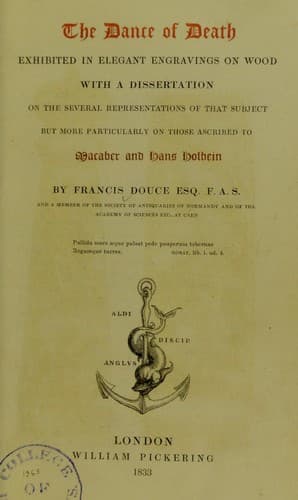
The Dance of Death: Exhibited in Elegant Engravings on Wood with a Dissertation on the Several Representations of that Subject but More Particularly on Those Ascribed to Macaber and Hans HolbeinDouce, Francis
History
The Dance of Death: Exhibited in Elegant Engravings on Wood with a Dissertation on the Several Representations of that Subject but More Particularly on Those Ascribed to Macaber and Hans Holbein
Douce, Francis
Bible. Old Testament -- Illustrations; Dance of death
In Boxgrove church, Sussex, there is a splendid and elaborately sculptured
monument of the Lords Delawar; and on the side which has not been engraved
in Mr. Dallaway's history of the county, there are two figures of Death
and a female, wholly unconnected with the other subjects on the tomb.
These figures are 9-1/2 inches in height, and of rude design. Many persons
will probably remember to have seen among the ballads, &c. that were
formerly, and are still exhibited on some walls in the metropolis, a poem,
intitled "Death and the Lady." This is usually accompanied with a
wood-cut, resembling the above figures. It is proper to mention likewise
on this occasion the old alliterative poem in Bishop Percy's famous
manuscript, intitled _Death and Liffe_, the subject of which is a
vision wherein the poet sees a contest for superiority between "our
Lady Dame Life," and the "ugly fiend, Dame Death." See "Percy's Reliques
of ancient English poetry," in the Essay on the Metre of Pierce Plowman's
Vision. Whether there may have been any connexion between these respective
subjects must be left to the decision of others. There is certainly some
reason to suppose so.
[Illustration]
The sculptures at Berlin and Fescamp have been already described.
Among the subjects of tapestry at the Tower of London, the most ancient
residence of our kings, was "the Dance of Macabre." See the inventory of
King Henry VIII.'s Guardrobe, &c. in MS. Harl. 1419, fo. 5.
Two panes of glass with a portion of a Dance of Death. 1. Three Deaths,
that appear to have been placed at the beginning of the Dance. Over them,
in a character of the time of Henry VII. these lines:
... ev'ry man to be contented w{t} his chaunce,
And when it shall please God to folowe my daunce.
2. Death and the Pope. No verses. Size, upright, 8-1/2 by 7 inches. In the
author's possession. They have probably belonged to a Macaber Dance in the
windows of some church.
CHAPTER XVII.
_Trois vifs et trois morts.--Negro figure of Death.--Danse aux
Avengles._
The first of these subjects, as connected with the Macaber Dance, has been
already introduced at p. 31-33; what is now added will not, it is
presumed, be thought unworthy of notice.
It is needless to repeat the descriptions that have been given by M.
Peignot of the manuscripts in the Duke de la Valliere's catalogue. The
following are some of the printed volumes in which representations of the
_trois vifs et trois morts_ occur.
They are to be found in all the editions of the Danse Macabre that have
already been described, and in the following Horæ and other service books
of the catholic church.
"Horæ ad usum Sarum," 1495, no place, no printer. 4to. Three Deaths, three
horsemen with hawks and hounds. The hermit, to whom the vision appeared,
in his cell.
"Heures à l'usaige de Rome." Paris. Nicolas Higman, for Guil. Eustace,
1506, 12mo.
"Horæ ad usum Traject." 1513. 18mo.
Public-domain text, read in full here on John Shaqi.
Reviews
Reviews
No reviews yet
Be the first to share your thoughts on this work.
Elsewhere in the archive
Join the Discussion
Join the discussion
Sign in to leave a comment or review.
Sign InorCreate an account