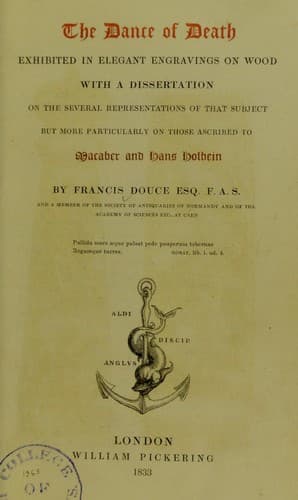
The Dance of Death: Exhibited in Elegant Engravings on Wood with a Dissertation on the Several Representations of that Subject but More Particularly on Those Ascribed to Macaber and Hans HolbeinDouce, Francis
History
The Dance of Death: Exhibited in Elegant Engravings on Wood with a Dissertation on the Several Representations of that Subject but More Particularly on Those Ascribed to Macaber and Hans Holbein
Douce, Francis
Bible. Old Testament -- Illustrations; Dance of death
Mr. Walpole, or rather Vertue, in the "Anecdotes of Painting in England,"
corrects the error of those who give the old Macaber Dance to Holbein, but
inadvertently makes that which is usually ascribed to him to have been
borrowed from the other.
Messrs. Huber and Rost make Holbein the engraver of the Lyons wood-cuts,
and suppose the original drawings to be preserved in the public library at
Basle. They probably allude to the problematical drawings that were used
by M. de Mechel, and which are now in Russia. "Manuel des curieux et des
amateurs de l'art." Tom. i. p. 155.
In the "Notices sur les graveurs," Besancon, 1807, 8vo. a work that has,
by some writers, been given to M. Malpé, and by others to the Abbé
Baverel, Papillon is followed with respect to the supposed edition of
1530, and its German verses.
Mr. Janssen is more inaccurate than any of his predecessors, some of whom
have occasionally misled him. He makes Albert Durer the inventor of the
designs, the greater part of which, he says, are from the Dance of Death
at Berne. He adopts the edition of 1530, and the German verses. He
condemns the title-page of the edition of 1562 for stating an addition of
seventeen plates, whereas, says he, there are but five; but the editor
meant only that there were seventeen more cuts than in the original, which
had only forty-one.
MISCELLANEOUS WRITERS.--Charles Patin, a libeller of the English nation,
has made Holbein the engraver on wood of a Dance of Death, which, he says,
is "not much unlike that in the church-yard of the Predicants at Basle,
painted, as some say, from the life, by Holbein." He ought to have known
that this work was executed near a century before Holbein was born.
"Erasmi stultitiæ laus." Basileæ, 1676, 8vo. at the end of the list of
Holbein's works.
Martiniere, in his Geographical Dictionary, makes Holbein the inventor of
the Macaber Dance at Basle.
Goujet, in his very useful "Bibliothéque Francoise," tom. x. p. 436, has
erroneously stated that the Lyons engravings on wood were by the
celebrated artist Salomon Bernard, usually called "Le petit Bernard." The
mistake is very pardonable, as it appears that Bernard chiefly worked in
the above city.
M. Compan, in his "Dictionnaire de Danse," 1787, 12mo. under the article
_Macabrée_, very gravely asserts that the author took his work from the
Maccabees, "qui, comme tout le monde scait danserent, et en ont fait
epoque pour les morts." He then quotes some lines from a modern edition of
the "Danse Macabre," where the word _Machabées_ is ignorantly substituted
for "Machabre."
M. Fournier states that Holbein painted a Dance of Death in the
fish-market at Basle, reduced it, and engraved it. "Dissertation sur
l'imprimerie," p. 70.
Public-domain text, read in full here on John Shaqi.
Reviews
Reviews
No reviews yet
Be the first to share your thoughts on this work.
Elsewhere in the archive
Join the Discussion
Join the discussion
Sign in to leave a comment or review.
Sign InorCreate an account