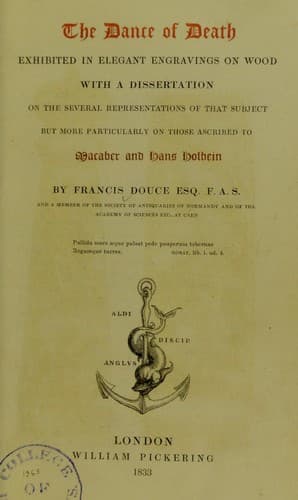
The Dance of Death: Exhibited in Elegant Engravings on Wood with a Dissertation on the Several Representations of that Subject but More Particularly on Those Ascribed to Macaber and Hans HolbeinDouce, Francis
History
The Dance of Death: Exhibited in Elegant Engravings on Wood with a Dissertation on the Several Representations of that Subject but More Particularly on Those Ascribed to Macaber and Hans Holbein
Douce, Francis
Bible. Old Testament -- Illustrations; Dance of death
Mr. Evelyn, in his "Sculptura," the only one of his works that does him no
credit, and which is a meagre and extremely inaccurate compilation, when
speaking of Holbein, actually runs riot in error and misconception. He
calls him a Dane. He makes what he terms "the licentiousness of the friars
and nuns," meaning probably Hollar's sixteen etchings after Holbein's
satire on monks and friars and other members of the Romish church as the
persecutors of Christ, and also the "Dance Machabre and Mortis imago," to
have been cut in wood, and one or both of the latter to have been painted
in the church of Basle. Mr. Evelyn's own copy of this work, with several
additions in manuscript, is in the possession of Mr. Taylor, a retired and
ingenious artist, of Cirencester-place. He probably intended to reprint
it, and opposite the above-mentioned word "Dane," has inserted a query.
Sandrart places the Dance of Death in the fish-market at Basle, and makes
Holbein the painter as well as the engraver. "Acad. artis pictoriæ," p.
238, edit. 1683, folio.
Baldinucci speaks of twenty prints of the Dance of Death painted by
Holbein in the Senate-house of Basle. "Notizie dè professori del disegno,
&c." tom. iii. 313 and 319.
M. Descamps inadvertently ascribes the old Dance of Death on the walls of
the church-yard of Saint Peter to the pencil of Holbein. "Vie des Peintres
Flamandi," &c. 1753. 8vo. Tom. i. p. 75.
Papillon, in his account of the Dance of Death, abounds with inaccuracies.
He says, that a magistrate of Basle employed him to paint a Dance of Death
in the fish-market, near a church-yard; that the work greatly increased
his reputation, and made much noise in the world, although it has many
anatomical defects; that he engraved this painting on small blocks of wood
with unparalleled beauty and delicacy. He supposes that they first
appeared in 1530 at Basle or Zuric, and as he thinks with a title and
German verses on each print. Now he had never seen any edition so early as
1530, nor any of the cuts with German verses, and having probably been
misled on this occasion, he has been the cause of misleading many
subsequent writers, as Fournier, Huber, Strutt, &c. He adopts the error as
to the mark [monogram: HL] on the thirty-sixth subject belonging to
Holbein. He is entirely ignorant of the nature and character of the fool
or idiot in No. xliii. whom he terms "un homme lascif qui a levé le devant
de sa robbe:" and, to crown the whole, he makes the old Macaber Dance an
_imitation_ of that ascribed to Holbein.
De Murr, in tom. ii. p. 535 of his "Bibliothéque de Peinture, &c."
servilely copies Papillon in all that he has said on the subject, with
some additional errors of his own.
The Abbé Fontenai, in the article for Holbein in his "Dictionnaire des
Artistes," Paris, 1776, 8vo. not only makes him the painter of the old
Macaber Dance, but places it in the town-house at Basle.
Public-domain text, read in full here on John Shaqi.
Reviews
Reviews
No reviews yet
Be the first to share your thoughts on this work.
Elsewhere in the archive
Join the Discussion
Join the discussion
Sign in to leave a comment or review.
Sign InorCreate an account