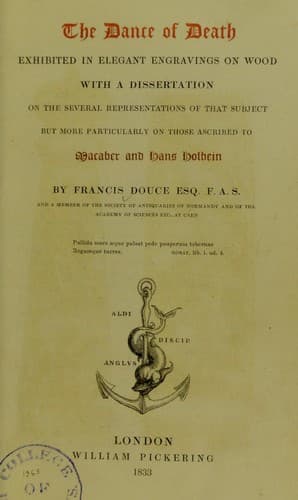
The Dance of Death: Exhibited in Elegant Engravings on Wood with a Dissertation on the Several Representations of that Subject but More Particularly on Those Ascribed to Macaber and Hans HolbeinDouce, Francis
History
The Dance of Death: Exhibited in Elegant Engravings on Wood with a Dissertation on the Several Representations of that Subject but More Particularly on Those Ascribed to Macaber and Hans Holbein
Douce, Francis
Bible. Old Testament -- Illustrations; Dance of death
Had Mr. Hegner written with a becoming diffidence in his opinions, his
work might have commanded and deserved respect, though greatly abounding
in error and false conceit. He has undertaken a task for which he has
shown himself wholly unqualified, and with much unseemly arrogance, and
its usual concomitant, ignorance, has assumed to himself a monopoly of
information on the subject which he discusses. His arguments, if worthy of
the name, are, generally speaking, of a most weak and flimsy texture. In
support of his dogmatical opinion that the original designs for the Lyons
Dance of Death exclusively belong to Holbein he has not adduced a single
fact. He has not been in possession of a tenth part of the materials that
were necessary for the proper investigation of his subject, nor does he
appear to have even seen them. The very best judges of whatever relates to
the history and art of engraving are quite satisfied that most of the
persons who have written on them, with the exception of Mr. Ottley, and of
the modest and urbane Monsieur Peignot, are liable to the charge of
extreme inaccuracy and imperfection in their treatment of the Dance of
Death, and the list of such writers may now be closed with the addition of
Herr Hegner.
Some of his positions are now to be stated and examined.
He makes Holbein the author of a new Dance of Death in the Crozat or
Gallitzin drawings in Indian ink which have been already described in the
present dissertation, adding that he also _engraved_ them, and suppressing
any mention in this place of the monogram on one of the cuts which he
_elsewhere admits not to belong to Holbein_. Soon afterwards, and with
very good reason, he doubts the originality of the drawings, which he says
M. de Mechel caused to be copied by Rudolph Schellenberg, a skilful
artist, already mentioned as the author of a Dance of Death of his own
invention; and proceeds to state, that from these copies De Mechel
employed some inferior persons in his service to make engravings;
advancing all this without the accompaniment of any proof whatever, and in
direct contradiction to De Mechel's authority of having himself engraved
them. An apparently bitter enemy to De Mechel, whose posthumous materials,
now in the library at Basle, he nevertheless admits to have used for his
work, he invidiously enlarges on the discrepancies between his engravings
and the Lyons wood-cuts, both in size and manner; and then concludes that
they were copied from the wood-cuts, the copyist allowing himself the
privilege of making arbitrary variations, especially in the figure of the
Eve in the second cut, which, he says, is of the family of Boucher, who,
in spite of Hegner's opinion, is regarded by better judges as a clever
painter. Whether the remarks on any deviations of De Mechel's prints from
the Crozat drawings are just or otherwise can now be decided by comparison
only, and Hegner does not appear to have seen them, or at least does not
tell us so.
Public-domain text, read in full here on John Shaqi.
Reviews
Reviews
No reviews yet
Be the first to share your thoughts on this work.
Elsewhere in the archive
Join the Discussion
Join the discussion
Sign in to leave a comment or review.
Sign InorCreate an account