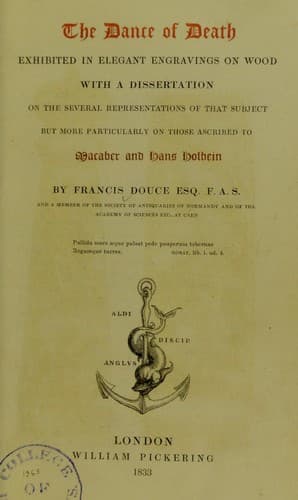
The Dance of Death: Exhibited in Elegant Engravings on Wood with a Dissertation on the Several Representations of that Subject but More Particularly on Those Ascribed to Macaber and Hans HolbeinDouce, Francis
History
The Dance of Death: Exhibited in Elegant Engravings on Wood with a Dissertation on the Several Representations of that Subject but More Particularly on Those Ascribed to Macaber and Hans Holbein
Douce, Francis
Bible. Old Testament -- Illustrations; Dance of death
His criticisms on the merit of the engravings in De Mechel's
work cannot be justified, for though they may occasionally be faulty, they
are very neatly, and many will think beautifully executed.
What Hegner has said respecting the alphabets of initial letters, is at
once futile and inaccurate; but his comment on Hans Lutzenberger deserves
the severest censure. Adverting to the inscription with the name of this
fine artist on one of the sets of the initials, he terms him "an itinerant
_bookseller_, who had bought the blocks and put his name on them;" and
this after having himself referred to a print on which Lutzenberger is
called FORMSCHNEIDER, _i. e._ woodcutter: making in this instance a clumsy
and dishonest effort to get rid of an excellent engraver, who stands so
recorded in opposition to his own untenable system.
The very important and indelible expressions in the dedication to the
first known edition of the Lyons wood-cuts, he very modestly terms "a play
upon words," and endeavours to account for the death of the painter by
supposing Holbein's absence in England would warrant the language of the
dedication. This is indeed a most desperate argument. Frellon, the
publisher and proprietor of the work, must have known better than to have
permitted the dedication to accompany his edition had it been susceptible
of so silly a construction.
He again adheres to the improbable notion that _Holbein engraved_ the cuts
to the Lyons book, and this in defiance of the mark or monogram [monogram:
HL] which this painter never used; nor will a single print with Holbein's
accredited name be found to bear the slightest resemblance to the style of
the wood-cuts. Even those in Cranmer's catechism, which approach the
nearest to them, are in a different manner. His earlier engravings on
wood, whether in design only, or as the engraver, resemble those by Urs
Graaf, who, as well as Holbein, decorated the frontispieces or titles to
many of the books printed at Basle. It is not improbable that Urs Graaf
was at that time a pupil of Holbein.
Public-domain text, read in full here on John Shaqi.
Reviews
Reviews
No reviews yet
Be the first to share your thoughts on this work.
Elsewhere in the archive
Join the Discussion
Join the discussion
Sign in to leave a comment or review.
Sign InorCreate an account