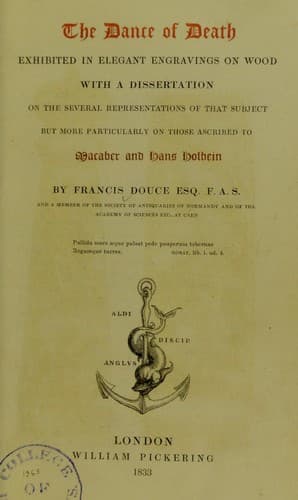
The Dance of Death: Exhibited in Elegant Engravings on Wood with a Dissertation on the Several Representations of that Subject but More Particularly on Those Ascribed to Macaber and Hans HolbeinDouce, Francis
History
The Dance of Death: Exhibited in Elegant Engravings on Wood with a Dissertation on the Several Representations of that Subject but More Particularly on Those Ascribed to Macaber and Hans Holbein
Douce, Francis
Bible. Old Testament -- Illustrations; Dance of death
[87] From the Author's own inspection.
[88] Recherches, p. 144, and see Catal. La Valliere, No. 295.
[89] Herbert's typogr. antiq. p. 888.
[90] Traité hist. de la gravure en bois, i. 182, 336.
[91] Letters containing an account of what seemed most remarkable in
Switzerland, Italy, &c. by G. Burnet, D. D. Rotterdam, 1686, 8vo. p. 265.
[92] Travels through Germany, &c. i. 138, edit. 4to.
[93] Relations historiques et curieuses de voyages en Allemagne, &c. Amst.
1695, 12mo. p. 124.
[94] See likewise Zuinger, Methodus Academica, Basle, 1577, 4to. p. 199.
[95] Remarks on several parts of Europe, 1738, vol. ii. p. 72.
[96] Peignot places the dance of peasants in the fish-market of Basle, as
other writers had the Dance of Death. Recherches, p. 15.
[97] Manuel de l'Amateur d'estampes, ii. 131.
[98] Manuel des curieux, &c. i. 156.
[99] Some give it to the Abbé Baverel.
[100] Lib. ult. p. 86.
[101] The dedicator has apparently in this place been guilty of a strange
misconception. The Death is not sucking the wine from the cask, but in the
act of untwisting the fastening to one of the hoops. Nor is the carman
crushed beneath the wheels: on the contrary, he is represented as standing
upright and wringing his hands in despair at what he beholds. It is true
that this cut was not then completed, and might have undergone some
subsequent alteration. He likewise speaks of the rainbow in the cut of the
Last Judgment, as being at that time unfinished, which, however, is
introduced in this first edition.
[102] It would be of some importance if the date of Lutzenberger's death
could be ascertained.
[103] "An enquiry into the origin and early history of Engraving," 1816,
4to. vol. ii. p. 759.
[104] "An Enquiry," &c. ii. 762.
[105] The few engravings by or after Holbein that have his name or its
initials are to be found in his early frontispieces or vignettes to books
printed at Basle. In 1548, two delicate wood-cuts, with his name, occur in
Cranmer's Catechism. In the title-page to "a lytle treatise after the
maner of an Epystle wryten by the famous clerk, Doctor Urbanus Regius,
&c." Printed by Gwalter Lynne, 1548, 24mo, there is a cut in the same
style of art of Christ attended by his disciples, and pointing to a
fugitive monk, whose sheep are scattered, and some devoured by a wolf.
Above and below are the words "John x. Ezech. xxxiiii. Mich. v. I am the
good shepehearde. A good shepehearde geveth his lyfe for the shype. The
hyred servaunt flyeth, because he is an hered servaunt, and careth not for
the shepe." On the cut at bottom HANS HOLBEIN. There is a fourth cut of
this kind in the British Museum collection with Christ brought before
Pilate; and perhaps Holbein might have intended a series of small
engravings for the New Testament; but all these are in a simple outline
and very different from the cuts in the Dance of Death, or Lyons Bible. It
might be difficult to refer to any other engravings belonging to Holbein
after the above year.
Public-domain text, read in full here on John Shaqi.
Reviews
Reviews
No reviews yet
Be the first to share your thoughts on this work.
Elsewhere in the archive
Join the Discussion
Join the discussion
Sign in to leave a comment or review.
Sign InorCreate an account