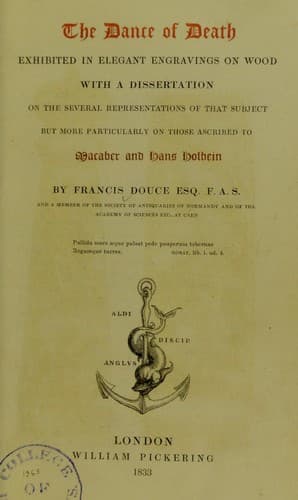
The Dance of Death: Exhibited in Elegant Engravings on Wood with a Dissertation on the Several Representations of that Subject but More Particularly on Those Ascribed to Macaber and Hans HolbeinDouce, Francis
History
The Dance of Death: Exhibited in Elegant Engravings on Wood with a Dissertation on the Several Representations of that Subject but More Particularly on Those Ascribed to Macaber and Hans Holbein
Douce, Francis
Bible. Old Testament -- Illustrations; Dance of death
[106] Brulliot dict. de monogrammes, &c. Munich, 1817, 4to. p. 418, where
the letter from De Mechel is given.
[107] Essai sur l'origine de la gravure, &c. tom. i. p. 260.
[108] Id. p. 261.
[109] Dict. de monogrammes, &c. tom. i. pp. 418, 499.
[110] Enciclop. metod. par ii. vol. vii. p. 16.
[111] Enciclop. metod. par. i. vol. x. p. 467.
[112] All the above prints are in the author's possession, except No. 7,
and his copy of No. 5 has not the tablets with the name, &c.
[113] Edit. Javigny, iv. 559.
[114] This edition is given on the authority of Peignot, p. 62, but has
not been seen by the author of this work. In the year 1547, there were
three editions, and it is not improbable that, by the transposition of the
two last figures, one of these might have been intended.
[115] Foppen's Biblioth. Belgica, i. 363.
[116] That of 1557 has a frontispiece with Death pointing to his
hour-glass when addressing a German soldier.
[117] Tom. i. p. 238, 525.
[118] Dict. de Monogrammes, col. 528.
[119] Biblioth. Belgica, i. 92.
[120] See p. 40.
[121] This is the same subject as that in the Augustan monastery described
in p. 48.
[122] See p. 34.
[123] It has been stated that they were in the Arundelian collection
whence they passed into the Netherlands, where forty-six of them became
the property of Jan Bockhorst the painter, commonly called Long John. See
Crozat's catalogue.
[124] On the same dedication are founded the opinions of Zani, De Murr,
Meintel, and some others.
[125] Zuinger methodus apodemica. Basil, 1557. 4to. p. 199.
[126] P. 427, edit. Lugd. apud Gryphium, and p. 445, edit. Basil.
[127] Nugæ, lib. vi. carm. 12.
[128] Baldinucci notizie d'é professori del disegno, tom. iii. p. 317,
4to. edit. where the inscription on it is given.
[129] Norfolk MS. 97, now in the Brit. Museum.
[130] Harl. MS. 4718.
[131] Acad. Pictur. 239.
[132] Strype's Annals, I. 272, where the curious dialogue that ensued on
the occasion is preserved.
[133] Catal. de la bibliothèque du Roi. II. 153.
[134] These initial letters have already been mentioned in p. 101-102. The
elegant initials in Dr. Henderson's excellent work on modern wines, and
those in Dr. Nott's Bristol edition of Decker's Gull's horn-book, should
not pass unnoticed on this occasion.
[135] See before in p. 97.
[136] Zani saw this alphabet at Dresden, and ascribes it likewise to
Lutzenberger. See his Enciclop. Metodica, Par. I. vol. x. p. 467.
[137] See before, in p. 46.
[138] Biblioth. Franc. tom. x. p. 436.
[139] Sandrart Acad. Pict. p. 241.
[140] Obs. on Spenser, II. 117, 118, 119.
Transcriber's Notes:
Passages in italics are indicated by _italics_.
Superscripted characters are indicated by {superscript}.
Letters printed in reverse are indicated by =X=.
Various printers' monograms are included throughout the original text.
These are represented by [monogram] or [monogram: description] if a
description could be provided.
Public-domain text, read in full here on John Shaqi.
Reviews
Reviews
No reviews yet
Be the first to share your thoughts on this work.
Elsewhere in the archive
Join the Discussion
Join the discussion
Sign in to leave a comment or review.
Sign InorCreate an account