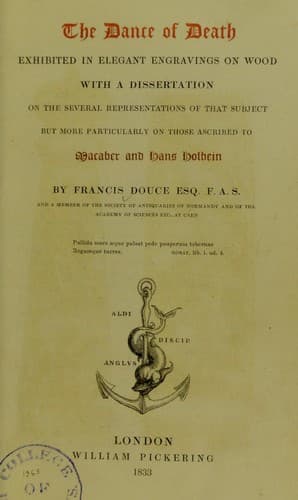
The Dance of Death: Exhibited in Elegant Engravings on Wood with a Dissertation on the Several Representations of that Subject but More Particularly on Those Ascribed to Macaber and Hans HolbeinDouce, Francis
History
The Dance of Death: Exhibited in Elegant Engravings on Wood with a Dissertation on the Several Representations of that Subject but More Particularly on Those Ascribed to Macaber and Hans Holbein
Douce, Francis
Bible. Old Testament -- Illustrations; Dance of death
After all, there seems to be a fatality of ambiguity in the account of the
Basle paintings ascribed to Holbein; and that of the Dance of Death has
not only been placed by several writers on the walls, inside and outside,
of houses, but likewise in the fish-market; on the walls of the
church-yard of St. Peter; and even in the cathedral itself of Basle; and,
therefore, amidst this chaos of description, it is absolutely impossible
to arrive at any conclusion that can be deemed in any degree satisfactory.
We are now to enter upon the investigation of a work which has been
somewhat erroneously denominated a "Dance of Death," by most of the
writers who have mentioned it. Such a title, however, is not to be found
in any of its numerous editions. It is certainly not a dance, but rather,
with slight exception, a series of admirable groups of persons of various
characters, among whom Death is appropriately introduced as an emblem of
man's mortality. It is of equal celebrity with the Macaber Dance, but in
design and execution of considerable superiority, and with which the name
of Hans Holbein has been so intimately connected, and that great painter
so generally considered as its inventor, that even to doubt his claim to
it will seem quite heretical to those who may have founded their opinion
on internal evidence with respect to his style of composition.
In the year 1538 there appeared a work with the following title, "Les
simulachres et historiees faces de la mort, autant elegamment
pourtraictes, que artificiellement imaginées." A Lyon Soubz lescu de
Coloigne, 4to. and at the end, "Excudebant Lugduni Melchior et Gaspar
Trechsel fratres, 1538." It has forty-one cuts, most exquisitely designed
and engraved on wood, in a manner which several modern artists only of
England and Germany have been competent to rival. As to the designs of
these truly elegant prints, no one who is at all skilled in the knowledge
of Holbein's style and manner of grouping his figures, would hesitate
immediately to ascribe them to that artist. Some persons have imagined
that they had actually discovered the portrait of Holbein in the subject
of the nun and her lover; but the painter, whoever he may have been, is
more likely to be represented in the last cut as one of the supporters of
the escutcheon of Death. In these designs, which are wholly different from
the dull and oftentimes disgusting Macaber Dance, which is confined, with
little exception, to two figures only, we have the most interesting
assemblage of characters, among whom the skeletonized Death, with all the
animation of a living person, forms the most important personage;
sometimes amusingly ludicrous, occasionally mischievous, but always busy
and characteristically occupied.
Public-domain text, read in full here on John Shaqi.
Reviews
Reviews
No reviews yet
Be the first to share your thoughts on this work.
Elsewhere in the archive
Join the Discussion
Join the discussion
Sign in to leave a comment or review.
Sign InorCreate an account