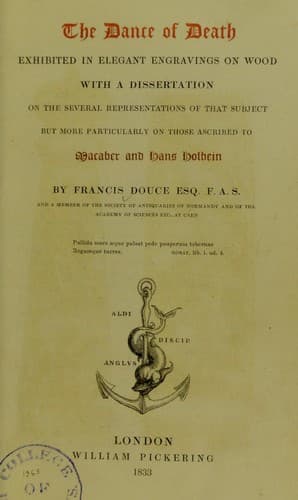
The Dance of Death: Exhibited in Elegant Engravings on Wood with a Dissertation on the Several Representations of that Subject but More Particularly on Those Ascribed to Macaber and Hans HolbeinDouce, Francis
History
The Dance of Death: Exhibited in Elegant Engravings on Wood with a Dissertation on the Several Representations of that Subject but More Particularly on Those Ascribed to Macaber and Hans Holbein
Douce, Francis
Bible. Old Testament -- Illustrations; Dance of death
of little consequence to his reader, and willingly omitted to go into
details which would have rendered his quaint moralizing in the above
passage less admissible. Besides, the additional cuts there spoken of
(eight cuts of the Dance of Death and four of boys) were afterwards
finished (doubtless by another wood-engraver, who had been brought up
under the eye of Holbein), and are not apparently inferior, whether in
respect of design or execution to the others. In short, these designs have
always been ascribed to Holbein, and designedly ranked amongst his finest
works."[103]
Mr. Ottley having admitted that the edition of the Dance of Death, printed
in quarto, at Lyons, 1538, is the earliest with which we are at present
acquainted, proceeds to state his belief that the cuts had been previously
and _certainly_ used at Basle. He then alludes to the supposed German
edition, about the year 1530, but acknowledges that he had not been able
to meet with or hear of any person who had seen it. He next introduces to
his reader's notice, and afterwards describes at large, a set of forty-one
impressions, being the complete series of the edition of 1538, except one,
and taken off with the greatest clearness and brilliancy of effect, on one
side of the paper only, each cut having over it its title printed in the
German language, with moveable type. He thinks it possible that they may
originally have had German verses underneath, and texts of Scripture
above, in addition to the titles; a fact, he adds, not now to be
ascertained, as the margins are clipped on the sides and at bottom. He
says, it is greatly to be regretted that the blocks were never taken off
with due diligence and good printing ink, after they got into the hands of
the Lyons booksellers, and then introduces into his page two fac-similes
of these cuts so admirably copied as to be almost undistinguishable from
the originals.[104] One may, indeed, regret with Mr. Ottley the _general
carelessness_ of the old printers in their mode of taking off impressions
from blocks of wood when introducing them into their books, and which is
so very unequally practised that, as already observed, the impressions are
often clearer and more distinct in later than in preceding editions. The
works of the old designers and engravers would, in many cases, have been
much more highly appreciated, if they had had the same justice done to
them by the printers as the editorial taste and judgment of Mr. Ottley,
combined with the skill of the workmen, have obtained in the decoration of
his own book. With respect to the impressions of the cuts in question,
when the blocks were in the hands of the Lyons booksellers, the fact is,
that in some of their editions they are occasionally as fine as those
separately printed off; and at the moment of making this remark, an
edition, published in 1547, at Lyons, is before the writer, in which many
of the prints are uncommonly clear and even brilliant, a circumstance
Public-domain text, read in full here on John Shaqi.
Reviews
Reviews
No reviews yet
Be the first to share your thoughts on this work.
Elsewhere in the archive
Join the Discussion
Join the discussion
Sign in to leave a comment or review.
Sign InorCreate an account