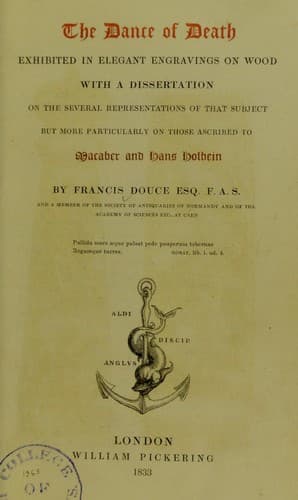
The Dance of Death: Exhibited in Elegant Engravings on Wood with a Dissertation on the Several Representations of that Subject but More Particularly on Those Ascribed to Macaber and Hans HolbeinDouce, Francis
History
The Dance of Death: Exhibited in Elegant Engravings on Wood with a Dissertation on the Several Representations of that Subject but More Particularly on Those Ascribed to Macaber and Hans Holbein
Douce, Francis
Bible. Old Testament -- Illustrations; Dance of death
owing, in a great degree, to the nature of the paper on which they are
impressed.
It were almost to be wished that this perplexing evidence against
Holbein's title to the invention of the work before us had never existed,
and that he had consequently been left in the quiet possession of what so
well accords with his exquisite pencil and extraordinary talents. True it
is, that the person to whom we owe this stubborn testimony, has manifested
a much more intimate acquaintance with the mode of conveying his pious
ejaculations to the Lady Abbess in the quaintest language that could
possibly have been chosen, than with the art of giving an accurate account
of the prints in question. Yet it seems scarcely possible that he should
have used the word _imagined_, which undoubtedly expresses originality of
invention, and not the mere act of copying, if he had referred to an
engraver on wood, whom he would not have dignified with the appellation of
a painter on whom he was bestowing the highest possible eulogium. There
would also have been much less occasion for the author's hyperbolical
fears on the part of Death in the case of an engraver, than in that of a
painter. He has stated that the rainbow subject, meaning probably that of
the Last Judgment, was left unfinished; but it appears among the
engravings in his edition. He must, therefore, have referred to a
painting, with which likewise the expression "bold shadows and
perspective," seem better to accord than with a slight engraving on wood.
He had also seen the subject of the waggon with the wine casks in its
unfinished state, and in this case we may almost with certainty pronounce
it to have been a painting, as the cut of it does not appear in the first
edition, furnishing, at the same time, an argument against Holbein's
claim; nor may it be unimportant to add that the dedicator, a religious
person, and probably a man of some eminence, was much more likely to have
been acquainted with the painter than with the engraver. The dedicator
also stamps the work as originating at Lyons; and Frellon, its printer, in
a complaint against a Venetian bookseller, who pirated his edition,
emphatically describes it as exclusively belonging to France.
Again, it is improbable that the dedicator, whoever he was, should have
preferred complimenting the engraver of the cuts, who, with all his
consummate skill, must, in point of rank and genius, be placed below the
painter or designer; and it is at the same time remarkable that the name
of Holbein is not adverted to in any of the early and genuine editions of
the work, published at Lyons, or any other place, whilst his designs for
the Bible have there been so pointedly noticed by his friend the poet
Borbonius.
Public-domain text, read in full here on John Shaqi.
Reviews
Reviews
No reviews yet
Be the first to share your thoughts on this work.
Elsewhere in the archive
Join the Discussion
Join the discussion
Sign in to leave a comment or review.
Sign InorCreate an account