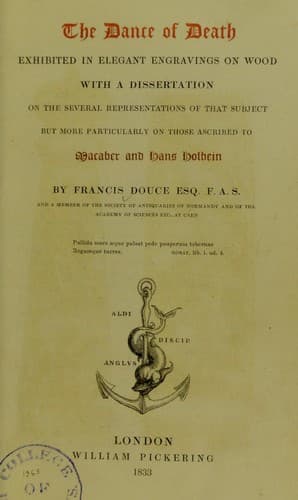
The Dance of Death: Exhibited in Elegant Engravings on Wood with a Dissertation on the Several Representations of that Subject but More Particularly on Those Ascribed to Macaber and Hans HolbeinDouce, Francis
History
The Dance of Death: Exhibited in Elegant Engravings on Wood with a Dissertation on the Several Representations of that Subject but More Particularly on Those Ascribed to Macaber and Hans Holbein
Douce, Francis
Bible. Old Testament -- Illustrations; Dance of death
It would be of some importance, if it could be shown, that the engraver
was dead in or before the year 1538, for that circumstance would
contribute to strengthen Mr. Ottley's opinion: but should it be found that
he did not die in or before 1538, it would follow, of course, that the
painter was the person adverted to in the dedication, and who consequently
could not be Holbein. It becomes necessary, therefore, to endeavour at
least to discover some other artist competent to the invention of the
beautiful designs in question; and whether the attempt be successful or
otherwise, it may, perhaps, be not altogether misplaced or unprofitable.
It must be recollected that Francis the First, on returning from his
captivity at Pavia, imported with him a great many Italian and other
artists, among whom were Lionardo da Vinci, Rosso, Primaticcio, &c. He is
also known to have visited Lyons, a royal city at that time eminent in art
of every kind, and especially in those of printing and engraving on wood;
as the many beautiful volumes published at that place, and embellished
with the most elegant decorations in the graphic art, will at this moment
sufficiently testify. In an edition of the "Nugæ" of Nicolas Borbonius,
the friend of Holbein, printed at Lyons, 1538, 8vo. are the following
lines:
_De Hanso Ulbio, et Georgio Reperdio, pictoribus._
Videre qui vult Parrhasium cum Zeuxide,
Accersat à Britannia
Hansum Ulbium, et Georgium _Reperdium_.
_Lugduno_ ab urbe Galliæ.
In these verses Reperdius is opposed to Holbein for the excellence of his
art, in like manner as Parrhasius had been considered as the rival of
Zeuxis.
After such an eulogium it is greatly to be regretted that notwithstanding
a very diligent enquiry has been made concerning an artist, who, by the
poet's comparative view of him, is placed on the same footing with
Holbein, and probably of the same school of painting, no particulars of
his life or works have been discovered. It is clear from Borbonius's lines
that he was then living at Lyons, and it is extremely probable that he
might have begun the work in question, and have died before he could
complete it, and that the Lyons publishers might afterwards have employed
Holbein to finish what was left undone, as well as to make designs for
additional subjects which appeared in the subsequent editions. Thus would
Holbein be so connected with the work as to obtain in future such notice
as would constitute him by general report the real inventor of it. If then
there be any validity in what is here stated concerning Reperdius, the
difficulty and obscurity in the preface to the Lyons edition of the Dance
of Death in 1538 will be removed, and Holbein remain in possession of a
share at least in the composition of that inestimable work. The mark or
monogram [monogram: HL] on one of the cuts cannot possibly belong to
Holbein, but may possibly be that of the engraver, of whom more
hereafter.
CHAPTER VII.
Public-domain text, read in full here on John Shaqi.
Reviews
Reviews
No reviews yet
Be the first to share your thoughts on this work.
Elsewhere in the archive
Join the Discussion
Join the discussion
Sign in to leave a comment or review.
Sign InorCreate an account