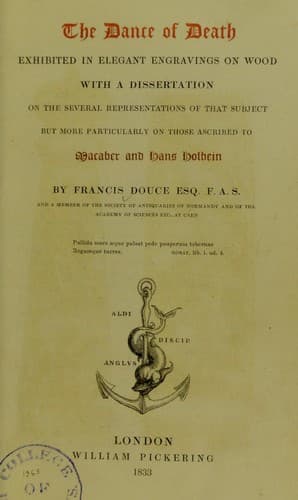
The Dance of Death: Exhibited in Elegant Engravings on Wood with a Dissertation on the Several Representations of that Subject but More Particularly on Those Ascribed to Macaber and Hans HolbeinDouce, Francis
History
The Dance of Death: Exhibited in Elegant Engravings on Wood with a Dissertation on the Several Representations of that Subject but More Particularly on Those Ascribed to Macaber and Hans Holbein
Douce, Francis
Bible. Old Testament -- Illustrations; Dance of death
[monogram: H] joined to a [monogram: B]; in which latter assertion M. de
Mechel was by no means correct.
On another alphabet of a Dance of Peasants, in the possession of the
writer of these pages, and undoubtedly by the same artists, M. de Mechel,
to whom it was shown when in England, has written in pencil, the following
memorandum: "[monogram: HL] gravè par Hans (John) Lutzenberger, graveur en
patrons à Basle, vivant là au commencement du 16me siecle;" but he has
inadvertently transferred the remark to the wrong alphabet, though both
were undoubtedly the work of the same artist, as well as a third alphabet,
equally beautiful, of groups of children.
The late Pietro Zani, whose intimate experience in whatever relates to
the art of engraving, together with the vast number of prints that had
passed under his observation, must entitle his opinions to the highest
consideration, has stated, in more places than one in his "Enciclopedia
Metodica," that Holbein had no concern with the cuts of the Lyons Dance of
Death, the engraving of which he decidedly ascribes to Hans Lutzenberger;
and, without any reference to the inscription on the proof of one of the
alphabets in the library at Basle before-mentioned, which he had probably
neither seen nor heard of, mentions the copy of one of the alphabets which
he had seen at Dresden, and at once consigns it to Lutzenberger. He
promises to resume the subject at large in some future part of his immense
work, which, if existing, has not yet made its appearance.
As the prints by this fine engraver are very few in number, and extremely
rare, the following list of them may not be unacceptable.
1. An oblong wood engraving, in length 11 inches by 3-1/2. It represents,
on one side, Christ requiring the attention of a group of eight persons,
consisting of a monk, a peasant with a flail, a female, &c. to a lighted
taper on a candelabrum placed in the middle of the print; on the other
side, a group of thirteen or fourteen persons, preceded by one who is
looking into a pit in which is the word PLATO. Over his head is inscribed
ARISTOTELES; he is followed by a pope, a bishop, monks, &c. &c.
2. Another oblong wood engraving, 6-1/2 inches by 2-1/2, in two
compartments, divided by a pillar. In one, the Judgment of Solomon; in the
other, Christ and the woman taken in adultery; he writes something on the
ground with his finger. It has the date 1539.
3. Another, size as No. 2. An emperor is sitting in a court of justice
with several spectators attending some trial. This is doubtful.
4. Another oblong print, 10-1/2 inches by 3, and in two compartments. 1.
David prostrate before the Deity in the clouds, accompanied by Manasses
and a youth, over whom is inscribed OFFEN SVNDER. 2. A pope on a throne
delivering some book, perhaps letters of indulgence, to a kneeling monk.
This very beautiful print has been called "The Traffic of Indulgences,"
and is minutely and correctly described by Jansen.[107]
Public-domain text, read in full here on John Shaqi.
Reviews
Reviews
No reviews yet
Be the first to share your thoughts on this work.
Elsewhere in the archive
Join the Discussion
Join the discussion
Sign in to leave a comment or review.
Sign InorCreate an account