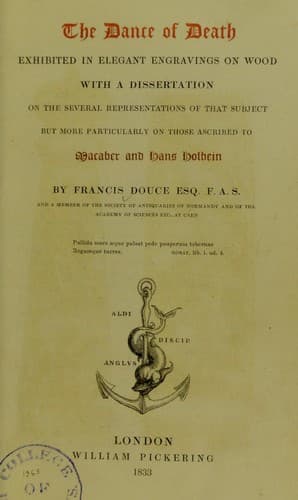
The Dance of Death: Exhibited in Elegant Engravings on Wood with a Dissertation on the Several Representations of that Subject but More Particularly on Those Ascribed to Macaber and Hans HolbeinDouce, Francis
History
The Dance of Death: Exhibited in Elegant Engravings on Wood with a Dissertation on the Several Representations of that Subject but More Particularly on Those Ascribed to Macaber and Hans Holbein
Douce, Francis
Bible. Old Testament -- Illustrations; Dance of death
The admission in the course of the preceding remarks that Holbein might
have been employed in some of the additional cuts that appeared in the
editions of the Lyons Dance of Death which followed that of 1538, may seem
at variance with what has been advanced with respect to the Bible cuts
ascribed to him. It is, however, by no means a matter of necessity that an
artist with Holbein's talents should have been resorted to for the purpose
of designing the additional cuts to the Lyons work. There were, during the
middle of the 16th century, several artists equally competent to the
undertaking, both as to invention and execution, as is demonstrable, among
numerous other instances, from the spurious, but beautiful, Italian copy
of the original cuts; from the scarcely distinguishable copies of the
Lyons Bible cuts in an edition put forth by John Stelsius at Antwerp,
1561, and from the works of several artists, both designers and
wood-engravers, in the books published by the French, Flemish, and Italian
booksellers at that period. An interesting catalogue raisonnè might be
constructed, though with some difficulty, of such articles as were
decorated with most exquisite and interesting embellishments. The above
century was much richer in this respect than any one that succeeded it,
displaying specimens of art that have only been rivalled, perhaps never
outdone, by the very skilful engravers on wood of modern times.
Our attention will, in the next place, be required to the excellent
_engraver_ of the Dance of Death, the thirty-sixth cut of which represents
the Duchess sitting up in bed, and accompanied with two figures of Death,
one of which plays on a violin, whilst the other drags away the
bed-clothes. On the base of one of the bed-posts is the mark or monogram
[monogram: HL] which has, among other artists, been inconsiderately
ascribed to Holbein. That it was intended to express the name of the
designer cannot be supported by evidence of any kind. We must then seek
for its meaning as belonging to the engraver, and whose name was, in all
probability, Hans Leuczellberger or Lutzenberger, sometimes called Franck.
M. de Mechel, the celebrated printseller and engraver at Basle, addressed
a letter to M. de Murr, in which he states that on a proof sheet of an
alphabet in the library in that city, containing several small figures of
a Dance of Death, he had found the above name. M. Brulliot remarks that he
had seen some of the letters of this alphabet, but had not perceived on
them either the name of Lutzenberger, or the mark [monogram: HL];[106] but
M. de Mechel has not said that the _mark_ was on the proof sheet, or on
the letters themselves, but only the name of Lutzenberger, adding that the
[monogram: HL] on the cut of the Duchess will throw some light on the
matter, and that Holbein, although this monogram has been usually ascribed
to him, never expressed his name by it, but used for that purpose an
Public-domain text, read in full here on John Shaqi.
Reviews
Reviews
No reviews yet
Be the first to share your thoughts on this work.
Elsewhere in the archive
Join the Discussion
Join the discussion
Sign in to leave a comment or review.
Sign InorCreate an account