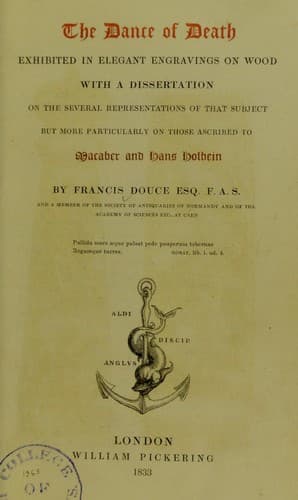
The Dance of Death: Exhibited in Elegant Engravings on Wood with a Dissertation on the Several Representations of that Subject but More Particularly on Those Ascribed to Macaber and Hans HolbeinDouce, Francis
History
The Dance of Death: Exhibited in Elegant Engravings on Wood with a Dissertation on the Several Representations of that Subject but More Particularly on Those Ascribed to Macaber and Hans Holbein
Douce, Francis
Bible. Old Testament -- Illustrations; Dance of death
republished this book in Latin, but without the dedication, and there are
impressions of them on single sheets, one of which has at the bottom, "In
Venetia, MDLXVIII. Fra. Valerio Faenzi Inquis. Apreso Luca Bertelli." So
that they required a license from the Inquisition.
II. In the absence of any other Italian editions of the "Simolachri," it
is necessary to mention that twenty-four of the last-mentioned cuts were
introduced in a work of extreme rarity, and which has escaped the notice
of bibliographers, intitled "Discorsi Morali dell' eccell. Sig. Fabio
Glissenti contra il dispiacer del morire. Detto Athanatophilia Venetia,
1609." 4to. These twenty-four were probably all that then remained; and
five others of subjects belonging also to the "Simolachri," are inserted
in this work, but very badly imitated, and two of them reversed. In the
subject of the Pope there is in the original a brace of grotesque devils,
one of which is completely erased in Glissenti, and a plug inserted where
the other had been scooped out. A similar rasure of a devil occurs in the
subject of the two rich men in conversation, the demon blowing with a
bellows into his ear, whilst a poor beggar in vain touches him to be
heard. Besides these cuts, Glissenti's work is ornamented with a great
number of others, connected in some way or other with the subject of
Death, which the author discusses in almost every possible variety of
manner. He appears to have been a physician, and an exceedingly pious man.
His portrait is prefixed to every division of the work, which consists of
five dialogues.
III. In an anonymous work, intitled "Tromba sonora per richiamar i morti
viventi dalla tomba della colpa alla vita della gratia. In Venetia, 1670."
8vo. Of which there had already been three editions; there are six of the
prints from the originals, as in the "Simolachri," &c. No. I. and a few
others, the same as the additional ones to Glissenti's work.
In another volume, intitled "Il non plus ultra di tutte le scienze
ricchezze honori, e diletti del mondo, &c. In Venetia, 1677." 24mo. There
are twenty-five of the cuts as in the Simolachri, and several others from
those added to Glissenti.
IV. A set of cuts which do not seem to have belonged to any work. They are
very close copies of the originals. On the subject of the Duchess in bed,
the letter [monogram: S] appears on the base of one of the pillars or
posts, instead of the original [monogram: HL], and it is also seen on the
cut of the soldier pierced by the lance of Death. Two have the date 1546.
In that of the monk, whom, in the original, Death seizes by the cowl or
hood, the artist has made a whimsical alteration, by converting the hood
into a fool's cap with bells and asses' ears, and the monk's wallet into a
fool's bauble. It is probable that he was of the reformed religion.
Public-domain text, read in full here on John Shaqi.
Reviews
Reviews
No reviews yet
Be the first to share your thoughts on this work.
Elsewhere in the archive
Join the Discussion
Join the discussion
Sign in to leave a comment or review.
Sign InorCreate an account