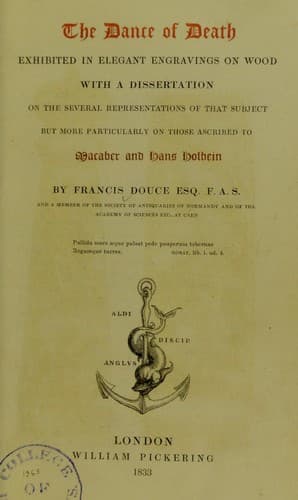
The Dance of Death: Exhibited in Elegant Engravings on Wood with a Dissertation on the Several Representations of that Subject but More Particularly on Those Ascribed to Macaber and Hans HolbeinDouce, Francis
History
The Dance of Death: Exhibited in Elegant Engravings on Wood with a Dissertation on the Several Representations of that Subject but More Particularly on Those Ascribed to Macaber and Hans Holbein
Douce, Francis
Bible. Old Testament -- Illustrations; Dance of death
Papillon, in his Traité de la gravure en bois, has given an elaborate,
but, as usual with him, a very faulty description of these engravings. He
enlarges on the beauty of the last cut with the allegorical coat of arms,
and particularly on that of the gentleman whose right hand he states to be
placed on its side, whilst it certainly is extended, and touches with the
back of it the mantle on which the helmet and shield of arms are placed.
He errs likewise in making the female look towards a sort of dog's head,
according to him, under the mantle and right hand of her husband, which,
he adds, might be taken for the pummell of his sword, and that she fondles
this head with her right hand, &c. not one word of which is correct. He
says that a good impression of this print would be well worth a Louis d'or
to an amateur. He appears to have been in possession of the block
belonging to the subject of the lovers preceded by Death with a drum; but
it had been spoiled by the stroke of a plane.
COPIES OF THE ABOVE DESIGNS, AND ENGRAVED ALSO ON WOOD.
I. At the head of these, in point of merit, must be placed the Italian
spurious edition mentioned in No. VII. of the preceding list. It is
entitled "Simolachri historie, e figure de la morte, ove si contiene la
medicina de l'anima utile e necessaria, non solo à gli ammalati, ma tutte
i sani. Et appresso, il modo, e la via di consolar gl'infermi. Un sermone
di S. Cipriano, de la mortalità. Due orationi, l'una a Dio, e l'altra à
Christo da dire appresso l'ammalato oppresso da grave infermitá. Un
sermone di S. Giovan Chrisostomo, che ci essorta à patienza; e che tratta
de la consumatione del secolo presente, e del secondo avenimento di Jesu
Christo, de la eterna felicita de giusti, de la pena e dannatione de rei;
et altre cose necessarie à ciascun Christiano, per ben vivere, e ben
morire. Con gratia e privilegio de l'illustriss. Senato Vinitiano, per
anni dieci. Appresso Vincenzo Vaugris al segno d'Erasmo, MDXLV." 12mo.
With a device of the brazen serpent, repeated at the end. It has all the
cuts in the genuine edition of the same date, except that of the beggar at
the gate. It contains a very moral dedication to Signor Antonio Calergi by
the publisher Vaugris or Valgrisi; in which, with unjustifiable
confidence, he enlarges on the great beauty of the work, the cuts in which
are, in his estimation, not merely equal, but far superior to those in the
French edition in design and engraving. They certainly approach the
nearest to the fine originals of all the imitations, but will be found on
comparison to be inferior. The mark [monogram: HL] on the cut of the
duchess sitting up in bed, with the two Deaths, one of whom is fiddling,
whilst the other pulls at the clothes, is retained, but this could not be
with a view to pass these engravings as originals, after what is stated in
the dedication. An artist's eye will easily perceive the difference in
spirit and decision of drawing. In the ensuing year 1546, Valgrisi
Public-domain text, read in full here on John Shaqi.
Reviews
Reviews
No reviews yet
Be the first to share your thoughts on this work.
Elsewhere in the archive
Join the Discussion
Join the discussion
Sign in to leave a comment or review.
Sign InorCreate an account