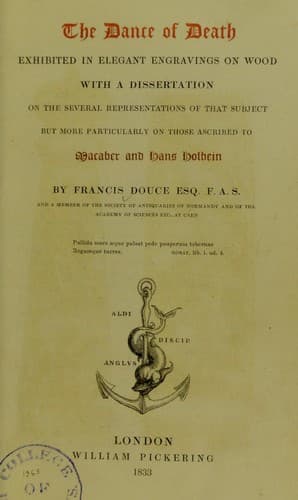
The Dance of Death: Exhibited in Elegant Engravings on Wood with a Dissertation on the Several Representations of that Subject but More Particularly on Those Ascribed to Macaber and Hans HolbeinDouce, Francis
History
The Dance of Death: Exhibited in Elegant Engravings on Wood with a Dissertation on the Several Representations of that Subject but More Particularly on Those Ascribed to Macaber and Hans Holbein
Douce, Francis
Bible. Old Testament -- Illustrations; Dance of death
flowers round its head, and is beating a bell with a bone. Under him is an
owl, and on the side of his left knee a scythe. The other Death has a cap
and feather, in his right hand an hour-glass, the left pointing to the
opposite figure. On the ground between them, a bow, a quiver of arrows and
a dart. On the left inner side of the gate a pot with holy water is
suspended to a ring, the sprinkler being a bone. Further on, within the
gate, is a flat stone, on which are several sculls and bones, a snake
biting one of the sculls. On the right hand corner at bottom is the letter
[monogram: A], perhaps the mark of the unknown engraver. The explanations
on the pages opposite to each print are in German and Latin verses, the
latter by Æmylius, with occasional variations. This edition has the sixty
prints in the two preceding Nos. some of them having been retouched; and
the cut of the King at table, No. 9, is by a different engraver from the
artist of the same No. in the preceding 4to. edition, No. I. The present
edition has also an additional engraving at the end, representing a gate,
within which are seen several sculls and bones, other sculls in a niche,
and in the distance a cemetery with coffins and crosses. Over the gate a
scull on each side, and on the outer edge of the arch is the inscription,
"Quis Rex, quis subditus hic est?" At bottom,
Hie sage wer es sagen kan | Here let tell who may:
Wer konig sey? wer unterthan. | Or, which be the king? which the subject?
Paulus Furst Excu.
The whole of the print in a border of sculls, bones, snakes, toads, and a
lizard. Opposite to it the date 1647 is to be gathered from the Roman
capitals in two scriptural quotations, the one in Latin, the other in
German, ending with this colophon, "Gedrucht zu Nuremberg durch Christoff
Lochner. In Verlegung Paul Fursten Kunsthandlern allda." 12mo.
IV. A set of engravings, 8 inches by 8, of which the subject of the
Pedlar, only has occurred on the present occasion. Instead of the
trump-marine, which one of the Deaths plays on in the original cut, this
artist has substituted a violin, and added a landscape in the back-ground.
Below are these verses:
LA MORT.
Sus? cesse ton traficq, car il fault à ceste heure
Que tu sente l'effort de mon dard asseré.
Tu as assez vescu, il est temps que tu meure,
Mon coup inevitable est pour toy preparé.
LE MARCHANT.
Et de grace pardon, arreste ta cholere.
Je suis pauvre marchant appaise ta rigueur.
Permete qu'encore un temps je vive en ceste terre:
Et puis tu recevras l'offrande de mon coeur.
Public-domain text, read in full here on John Shaqi.
Reviews
Reviews
No reviews yet
Be the first to share your thoughts on this work.
Elsewhere in the archive
Join the Discussion
Join the discussion
Sign in to leave a comment or review.
Sign InorCreate an account