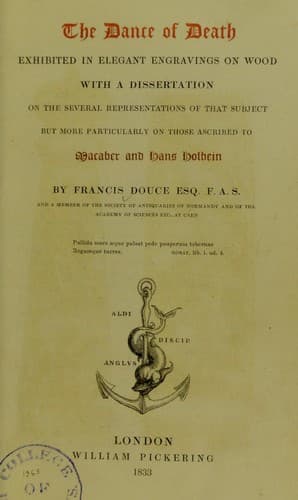
The Dance of Death: Exhibited in Elegant Engravings on Wood with a Dissertation on the Several Representations of that Subject but More Particularly on Those Ascribed to Macaber and Hans HolbeinDouce, Francis
History
The Dance of Death: Exhibited in Elegant Engravings on Wood with a Dissertation on the Several Representations of that Subject but More Particularly on Those Ascribed to Macaber and Hans Holbein
Douce, Francis
Bible. Old Testament -- Illustrations; Dance of death
V. A set of thirty etchings by Wenceslaus Hollar, within elegant frames or
borders designed by Diepenbecke, of which there are three varieties. The
first of these has at the top a coffin with tapers, at bottom, Death lying
prostrate. The sides have figures of time and eternity. At bottom, _Ab.
Diepenbecke inv. W. Hollar fecit_. The second has at top a Death's head
crowned with the Papal tiara; at bottom, a Death's head with cross-bones
on a tablet, accompanied by a saw, a globe, armour, a gun, a drum, &c. On
the sides are Hercules and Minerva. At bottom, _Ab. Diepenbecke inv. W.
Hollar fecit, 1651_. The third has at top a Death's head, an hour-glass
winged between two boys; at bottom, a Death's head and cross-bones on a
tablet between two boys holding hour-glasses. On the sides, Democritus and
Heraclitus with fools' caps. This border has no inscription below. As
these etchings are not numbered, the original arrangement of them cannot
be ascertained. The names of Diepenbecke and Hollar are at the bottom of
several of the borders, &c. On the subject of the Queen is the mark
[monogram: UH] and on three others that of [monogram: WH]. This is the
first and most desirable state of the work, the borders having afterwards
fallen into the hands of Petau and Van Morle, two foreign printsellers,
whose impressions are very inferior. It has not been ascertained what
became of these elegant additions, but the work afterwards appeared
without them, and with the additional mark [monogram: HB] _i._ on every
print, and intended for Holbein invenit. It is very certain that Hollar
himself did not place this mark on the prints; he has never introduced it
in any of his copies from Holbein, always expressing that painter's name
in these several ways: [monogram: HH], [monogram: HHolbein] _inv._
[monogram: HHolbein] _pinxit_, H. HOLBEIN inv. H. HOLBEIN inventor. On one
of his portraits from the Arundel collection he has placed "[monogram:
HHolbein] _incidit in lignum_." No copy, however, of this portrait has
occurred in wood, and, if this be only a conjecture on the part of the
engraver, the distance of time between the respective artists is an
objection to its validity, though it is possible that Holbein might have
engraved on wood, because there are prints which have all the appearance
of belonging to him, that have his usual mark, accompanied by an engraving
tool. There is no text to these etchings, except the Latin scriptural
passages under each, that occur in the original editions in that language.
As a sort of frontispiece to the work, Hollar has transferred the last cut
of the allegorical shield of arms, supported by a lady and gentleman, to
the beginning, with the appropriate title of MORTALIVM NOBILITAS. The
other subjects are, 1. Adam and Eve in Paradise. 2. Their expulsion from
Paradise. 3. Adam digging, Eve spinning. 4. The Pope. 5. The Emperor. 6.
The Empress. 7. The Queen. 8. The Cardinal. 9. The Duke. 10. The Bishop.
11. The Nobleman. 12. The Abbot. 13.
Public-domain text, read in full here on John Shaqi.
Reviews
Reviews
No reviews yet
Be the first to share your thoughts on this work.
Elsewhere in the archive
Join the Discussion
Join the discussion
Sign in to leave a comment or review.
Sign InorCreate an account