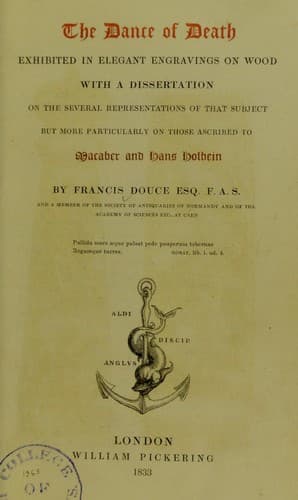
The Dance of Death: Exhibited in Elegant Engravings on Wood with a Dissertation on the Several Representations of that Subject but More Particularly on Those Ascribed to Macaber and Hans HolbeinDouce, Francis
History
The Dance of Death: Exhibited in Elegant Engravings on Wood with a Dissertation on the Several Representations of that Subject but More Particularly on Those Ascribed to Macaber and Hans Holbein
Douce, Francis
Bible. Old Testament -- Illustrations; Dance of death
IX. "Imagines Mortis, or the Dead Dance of Hans Holbeyn, painter of King
Henry the VIII." This title is on a copper-plate within a border, and
accompanied with nineteen etchings on copper, by Nieuhoff Piccard, a
person who will be more particularly adverted to hereafter. They consist
of, 1. The emblem of Mortality. 2. The temptation. 3. The expulsion from
Paradise. 4. Adam digging, Eve spinning. 5. Concert of Deaths. 6. The
Infant. 7. The new married couple. 8. The Duke. 9. The Advocate. 10. The
Abbot. 11. The Monk. 12. The Abbess. 13. The Soldier. 14. The Merchant.
15. The Pedler. 16. The Fool. 17. The Blind Man. 18. The Old Woman. 19.
The Old Man. The designs, with some occasional variations, correspond with
those in the original wood-cuts. The plates of these etchings must have
passed into the hands of some English printsellers, as broken sets of them
have not long since been seen, one only of which, namely, that of the
Temptation, had these lines on it:
"All that e'er had breath
Must dance after Death."
with the date 1720. Several were then numbered at bottom with Arabic
numerals.
X. "Schau-platz des Todes, oder Todten Tanz, von Sal. Van Rusting Med.
Doct. in Nieder-Teutscher-Spracke nun aber in Hoch Teutscher mit nothigen
Anmerchungen heraus gegeben von Johann Georg. Meintel Hochfurstl
Brandenburg-Onoltzbachischen pfarrer zu Petersaurach." Nurnberg, 1736.
8vo. Or, "The Theatre of Death, or Dance of Death, by Sol. Van Rusting,
doctor of medicine, in Low German language, but now in High German, with
necessary notes by John George Meintel in the service of his Serene
Highness of Brandenburg, and parson of Petersaurach." It is said to have
been originally published in 1707, which is very probable, as Rusting, of
whom very little is recorded, was born about 1650. In the early part of
his life he practised as an army surgeon. He was a great admirer and
follower of the doctrines of Balthasar Bekker in his "Monde enchanté."
There are editions in Dutch only, 1735 and 1741. 12mo. the plates being
copies. In the above-mentioned edition by Meintel there is an elaborate
preface, with some account of the Dance of Death, and its editions, but
replete with the grossest errors, into which he has been misled by
Hilscher, and some other writers. His text is accompanied with a profusion
of notes altogether of a pious and moral nature.
Rusting's work consists of thirty neat engravings, of which the following
are copied from the Lyons wood-cuts. 1. The King, much varied. 2. The
Astrologer. 3. The Soldier. 4. The Monk. 5. The Old Man. 6. The Pedler.
The rest are, on the whole, original designs, yet with occasional hints
from the Lyons cuts; the best of them are, the Masquerade, the
Rope-dancer, and the Skaiters. The frontispiece is in two compartments;
the upper one, Death crowned, sitting on a throne, on each side of him a
Death trumpeter; the lower, a fantastic Dance of seven Deaths, near a
crowned skeleton lying on a couch.
Public-domain text, read in full here on John Shaqi.
Reviews
Reviews
No reviews yet
Be the first to share your thoughts on this work.
Elsewhere in the archive
Join the Discussion
Join the discussion
Sign in to leave a comment or review.
Sign InorCreate an account