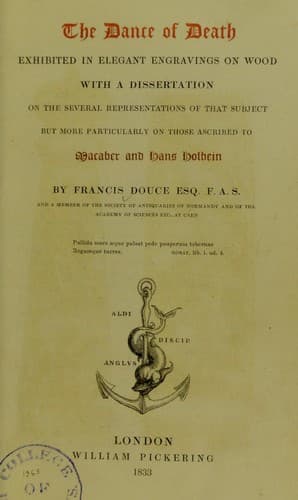
The Dance of Death: Exhibited in Elegant Engravings on Wood with a Dissertation on the Several Representations of that Subject but More Particularly on Those Ascribed to Macaber and Hans HolbeinDouce, Francis
History
The Dance of Death: Exhibited in Elegant Engravings on Wood with a Dissertation on the Several Representations of that Subject but More Particularly on Those Ascribed to Macaber and Hans Holbein
Douce, Francis
Bible. Old Testament -- Illustrations; Dance of death
VII. "Theatrum mortis humanæ tripartitum. I. Pars. Saltum Mortis. II.
Pars. Varia genera Mortis. III. Pars. Pænas Damnatorum continens, cum
figuris æneis illustratum." Then the same repeated in German, with the
addition "Durch Joannem Weichardum Valvasor. Lib. Bar. cum facultate
superiorum, et speciali privilegio Sac. Cæs. Majest. Gedrucht zu Laybach,
und zu finden ben Johann Baptista Mayr, in Saltzburg. Anno 1682. 4to."
Prefixed is an engraved frontispiece representing a ruined arch, under
which is a coffin, and before it the King of Terrors between two other
figures of Death mounted respectively on an elephant and camel. In the
foreground, Adam and Eve, tied to the forbidden tree of knowledge, between
several other Deaths variously employed. Two men digging graves, &c.
Underneath, "[monogram: W.] inven. [monogram: W.] excud. Jo. Koch del.
And. Trost sculp. Wagenpurgi in Carniola." It is the first part only with
which we are concerned. The artist, with very little exception, has
followed and reversed the spurious wood-cuts of 1555, by [monogram: SA].
To the groups of boys he has added a Death leading them on.
VIII. "De Doodt vermaskert met des werelts ydelheyt afghedaen door
Geeraerdt Van Wolschaten." This is another edition of No. IX. of the
original wood-cuts, here engraved on _copper_. The text is the same as
that of 1654, with the addition of seven leaves, including a cut of Death
leading all ranks of men. In that of the Pedler the artist has introduced
some figures in the distance of the original _soldier_. Among other
variations the costume of the time of William III. is sometimes very
ludicrously adopted, especially in the frontispiece, where the author is
represented writing at a desk, and near him two figures of a man in a full
bottom wig, and a woman with a mask and a perpendicular cap in several
stories, usually called a _Fontange_, both having skeleton faces. At
bottom, the mark [monogram: L B.f.]. This edition was printed at Antwerp
by Jan Baptist Jacobs, without date, but the privilege has that of 1698.
12mo.
Public-domain text, read in full here on John Shaqi.
Reviews
Reviews
No reviews yet
Be the first to share your thoughts on this work.
Elsewhere in the archive
Join the Discussion
Join the discussion
Sign in to leave a comment or review.
Sign InorCreate an account