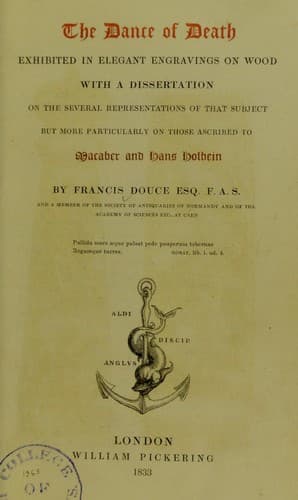
The Dance of Death: Exhibited in Elegant Engravings on Wood with a Dissertation on the Several Representations of that Subject but More Particularly on Those Ascribed to Macaber and Hans HolbeinDouce, Francis
History
The Dance of Death: Exhibited in Elegant Engravings on Wood with a Dissertation on the Several Representations of that Subject but More Particularly on Those Ascribed to Macaber and Hans Holbein
Douce, Francis
Bible. Old Testament -- Illustrations; Dance of death
M. Mechel has added another print on this subject, viz. the sheath of a
dagger, a design for a chaser. It is impossible to exceed the beauty and
skill that are manifested in this fine piece of art. The figures are, a
king, queen, warrior, a young woman, a monk, and an infant, all of whom
most unwillingly accompany Death in the dance. The despair of the king,
the dejection of the queen, accompanied by her little dog, the terror of
the soldier who hears the drum of Death, the struggling of the female, the
reluctance of the monk, and the sorrow of the poor infant, are depicted
with equal spirit and veracity. The original drawing is in the public
library at Basle, and ascribed to Holbein. There is a general agreement
between these engravings and the original wood-cuts. Twenty-three are
reversed. In No. 13 the jaw-bone in the hand of Death is not distinct. In
No. 16 a cross is added, and in No. 17 two heads.
Mr. Coxe, in his Travels in Switzerland, has given some account of the
drawings copied as above by M. de Mechel, in whose possession he saw them.
He states that they were sketched with a pen, and slightly shaded with
Indian ink. He mentions M. de Mechel's conjecture that they were once in
the Arundel collection, and infers from thence that they were copied by
Hollar, which, however, from what has been already stated on the subject
of Hollar's print of the Soldier and Death, as well as from other
variations, could not have been the case. Mr. Coxe proceeds to say that
four of the subjects in M. de Mechel's work are not in the drawings, but
were copied from Hollar. It were to be wished that he had specified them.
The particulars that follow were obtained by the compiler of the present
dissertation from M. de Mechel himself when he was in London. He had not
been able to trace the drawings previously to their falling into the hands
of M. de Crozat,[123] at whose sale, about 1771, they were purchased by
Counsellor Fleischmann of Strasburg, and M. de Mechel having very
emphatically expressed his admiration of them whilst they were in the
possession of M. Fleischmann, that gentleman very generously offered them
as a present to him. M. de Mechel, however, declined the offer, but
requested they might be deposited in the public library at Basle, among
other precious remains of Holbein's art. This arrangement, however, did
not take place, and it happened in the mean time that two nephews of
Prince Gallitzin, minister from Russia to the court of Vienna, having
occasion to visit M. Fleischmann, then much advanced in years, and his
memory much impaired, prevailed on him to concede the drawings to their
uncle, who, on learning from M. de Mechel what had originally passed
between himself and M. Fleischmann, sent the drawings to him, with
permission to engrave and publish them, which was accordingly done, after
they had been detained two years for that purpose. They afterwards passed
into the Emperor of Russia's collection of fine arts at Petersburg.
Public-domain text, read in full here on John Shaqi.
Reviews
Reviews
No reviews yet
Be the first to share your thoughts on this work.
Elsewhere in the archive
Join the Discussion
Join the discussion
Sign in to leave a comment or review.
Sign InorCreate an account