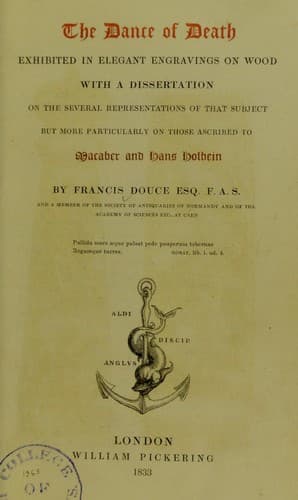
The Dance of Death: Exhibited in Elegant Engravings on Wood with a Dissertation on the Several Representations of that Subject but More Particularly on Those Ascribed to Macaber and Hans HolbeinDouce, Francis
History
The Dance of Death: Exhibited in Elegant Engravings on Wood with a Dissertation on the Several Representations of that Subject but More Particularly on Those Ascribed to Macaber and Hans Holbein
Douce, Francis
Bible. Old Testament -- Illustrations; Dance of death
It were greatly to be wished that some person qualified like Mr. Ottley,
if such a one can be found, would take the trouble to enter on a critical
examination of these drawings in their present state, with a view to
ascertain, as nearly as possible, whether they carry indisputable marks of
Holbein's art and manner of execution, or whether, as may well be
suspected, they are nothing more than copies, either by himself or some
other person, from the original wood engravings.
M. de Mechel had begun this work in 1771, when he had engraved the first
four subjects, including a frontispiece totally different from that in the
volume here described. There are likewise variations in the other three.
He was extremely solicitous that these should be cancelled.
XII. David Deuchar, sometimes called the Scottish Worlidge, who has etched
many prints after Ostade and the Dutch masters, published a set of
etchings by himself, with the following printed title: "The Dances of
Death through the various stages of human life, wherein the capriciousness
of that tyrant is exhibited in forty-six copper-plates, done from the
original designs, which were cut in wood and afterwards painted by John
Holbein in the town house at Basle, to which is prefixed descriptions of
each plate in French and English, with the scripture text from which the
designs were taken. Edinburgh, MDCCLXXXVIII." Before this most inaccurate
title are two engraved leaves, on one of which is Deuchar's portrait, in a
medallion, supported by Adam and Eve holding the forbidden fruit. Over the
medallion, the three Fates, the whole within an arch before a pediment. On
each side, a plain column, supporting a pyramid, &c. On the other leaf a
copy of the engraved title to M. de Mechel's work with the substitution of
Deuchar's name. After the printed title is a portrait, as may be supposed,
of Holbein, within a border containing six ovals of various subjects, and
a short preface or account of that artist, but accompanied with some very
inaccurate statements. The subjects are inclosed, like Hollar's, within
four different borders, separately engraved, three of them borrowed, with
a slight variation in one, from Diepenbeke, the fourth being probably
Deuchar's invention. The etchings of the Dance of Death are forty-six in
number, accompanied with De Mechel's description and English translation.
At the end is the emblematical print of mortality, but not described, with
the dagger sheath, copied from De Mechel. Thirty of these etchings are
immediately copied from Hollar, No. X. having the distance altered. The
rest are taken from the spurious wood copies of the originals by
[monogram: SA] with variation in No. XVIII.; and in No. XXXIX. and XLIII.
Deuchar has introduced winged hour-glasses. These etchings are very
inferior to those by Hollar. The head of Eve in No. III. resembles that of
a periwigged Frenchman of the time of Louis XIV. but many of the subjects
Public-domain text, read in full here on John Shaqi.
Reviews
Reviews
No reviews yet
Be the first to share your thoughts on this work.
Elsewhere in the archive
Join the Discussion
Join the discussion
Sign in to leave a comment or review.
Sign InorCreate an account