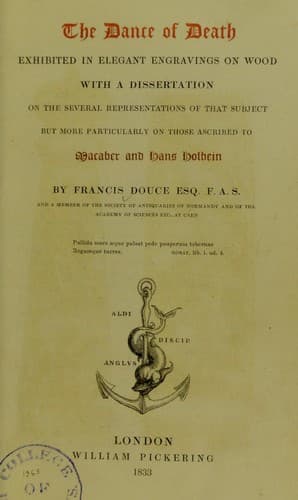
The Dance of Death: Exhibited in Elegant Engravings on Wood with a Dissertation on the Several Representations of that Subject but More Particularly on Those Ascribed to Macaber and Hans HolbeinDouce, Francis
History
The Dance of Death: Exhibited in Elegant Engravings on Wood with a Dissertation on the Several Representations of that Subject but More Particularly on Those Ascribed to Macaber and Hans Holbein
Douce, Francis
Bible. Old Testament -- Illustrations; Dance of death
The numerous errors that have been fallen into in making Holbein a
participator in any manner whatever with the old Basle Macaber Dance, have
been already noticed, and are indeed not worth the trouble of refuting. It
is wholly improbable that he would interfere with so rude a piece of art;
nor has his name been recorded among the artists who are known to have
retouched or repaired it. The Macaber Dance at Basle, or any where else,
is, therefore, with respect to Holbein, to be altogether laid aside; and
if the argument before deduced from the important dedication to the
edition of the justly celebrated wood-cuts published at Lyons in 1538 be
of any value, his claim to their invention, at least to those in the first
edition, must also be rejected.[124] There is indeed but very slight
evidence, and none contemporary, that he painted any Dance of Death at
Basle. The indefinite statements of Bishop Burnet and M. Patin, together
with those of the numerous and careless travellers who have followed
blind leaders, and too often copied each other without the means or
inclination of obtaining correct information, are deserving of very little
attention. The circumstance of Holbein's having painted a Dance of
Peasants somewhere in the above city, in conjunction with the usual
mistake of ascribing to him the old Macaber Dance, seems to have
occasioned the above erroneous statements as to a Dance of Death by his
pencil. It is hardly possible that Zuinger, almost a contemporary, when
describing the Dance of Peasants and other paintings by Holbein at Basle
would have omitted the mention of any Dance of Death:[125] but even
admitting the former existence of such a painting, it would not constitute
him the inventor of the designs in the Lyons work. He might have imitated
or copied those designs, or the wood-cuts themselves, or perhaps have
painted subjects that were different from either.
We are now to take into consideration some very clear and important
evidence that Holbein actually _did paint a Dance of Death_. This is to be
found in the _Nugæ_ of Borbonius in the following verses:
_De morte picta à Hanso pictore nobili._
Dum mortis Hansus pictor imaginum exprimit,
Tanta arte mortem retulit, ut mors vivere
Videatur ipsa: et ipse se immortalibus
Parem Diis fecerit, operis hujus gloria.[126]
Public-domain text, read in full here on John Shaqi.
Reviews
Reviews
No reviews yet
Be the first to share your thoughts on this work.
Elsewhere in the archive
Join the Discussion
Join the discussion
Sign in to leave a comment or review.
Sign InorCreate an account