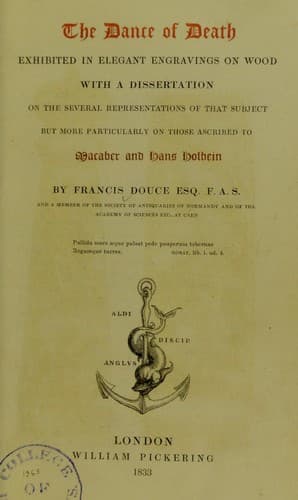
The Dance of Death: Exhibited in Elegant Engravings on Wood with a Dissertation on the Several Representations of that Subject but More Particularly on Those Ascribed to Macaber and Hans HolbeinDouce, Francis
History
The Dance of Death: Exhibited in Elegant Engravings on Wood with a Dissertation on the Several Representations of that Subject but More Particularly on Those Ascribed to Macaber and Hans Holbein
Douce, Francis
Bible. Old Testament -- Illustrations; Dance of death
It has been already demonstrated that these lines could not refer to the
old painting of the Macaber Dance at the Dominican convent, whilst, from
the important dedication to the edition of the wood-cuts first published
at Lyons in 1538, it is next to impossible that that work could then have
been in Borbonius's contemplation. It appears from several places in his
Nugæ that he was in England in 1535, at which time Holbein drew his
portrait in such a manner as to excite his gratitude and admiration in
another copy of verses.[127] This was probably the chalk drawing still
preserved in the fine collection of portraits of the eminent persons in
the court of Henry VIII. formerly at Kensington, and thence removed to
Buckingham House, and which has been copied in an elegant wood-cut, that
first appeared in the edition of the Paidagogeion of Borbonius, Lyons,
1536, and afterward in two editions of his Nugæ. It is inscribed NIC.
BORBONIVS VANDOP. ANNO ÆTATIS XXXII. 1535. He returned to Lyons in 1536,
and it is known that he was there in 1538, when he probably wrote the
complimentary lines in Holbein's Biblical designs a short time before
their publication, either out of friendship to the painter, or at the
instance of the Lyons publisher with whom he was certainly connected.
Now if Borbonius, during his residence at Lyons, had been assured that the
designs in the wood-cuts of the Dance of Death were the production of
Holbein, would not his before-mentioned lines on that subject have been
likewise introduced into the Lyons edition of it, or at least into some
subsequent editions, in none of which is any mention whatever made of
Holbein, although the work was continued even after the death of that
artist? The application, therefore, of Borbonius's lines must be sought
for elsewhere; but it is greatly to be regretted that he has not adverted
to the place where the painting, as he seems to call it, was made.
Very soon after the calamitous fire at Whitehall in 1697, which consumed
nearly the whole of that palace, a person calling himself T. Nieuhoff
Piccard, probably belonging to the household of William the Third, and a
man who appears to have been an amateur artist, made the etchings in the
article IX. already described in p. 130. Copies of them were presented to
some of his friends, with manuscript dedications to them. Three of these
copies have been seen by the author of this Dissertation, and as the
dedications differ from each other, and are of very considerable
importance on the present occasion, the following extracts from them are
here translated and transcribed:
"TO MYNHEER HEYMANS.
Public-domain text, read in full here on John Shaqi.
Reviews
Reviews
No reviews yet
Be the first to share your thoughts on this work.
Elsewhere in the archive
Join the Discussion
Join the discussion
Sign in to leave a comment or review.
Sign InorCreate an account