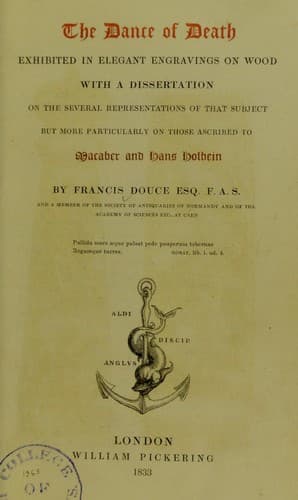
The Dance of Death: Exhibited in Elegant Engravings on Wood with a Dissertation on the Several Representations of that Subject but More Particularly on Those Ascribed to Macaber and Hans HolbeinDouce, Francis
History
The Dance of Death: Exhibited in Elegant Engravings on Wood with a Dissertation on the Several Representations of that Subject but More Particularly on Those Ascribed to Macaber and Hans Holbein
Douce, Francis
Bible. Old Testament -- Illustrations; Dance of death
I. "Les loups ravissans fait et composé par maistre Robert Gobin prestre,
maistre es ars licencie en decret, doyen de crestienté de Laigny sur Marne
au dyocese de Paris, advocat en court d'eglise. Imprimé pour Anthoine
Verard a Paris, 4to." without date, but about 1500. This is a very bitter
satire, in the form of a dream, against the clergy in general, but more
particularly against Popes John XXII. and Boniface VIII. A wolf, in a
lecture to his children, instructs them in every kind of vice and
wickedness, but is opposed, and his doctrines refuted, by an allegorical
personage called Holy Doctrine. In a second vision Death appears to the
author, accompanied by Fate, War, Famine, and Mortality. All classes of
society are formed into a Dance, as the author chooses to call it, and the
work is accompanied with twenty-one very singular engravings on wood,
executed in a style perhaps nowhere else to be met with. The designs are
the same as those in the second Dance of the Horæ, printed by Higman for
Vostre, No. I. page 61.
II. "A booke of Christian prayers, collected out of the ancient writers,
&c." Printed by J. Day, 1569. 4to. Afterwards in 1578, 1581, 1590, and
1609. It is more frequently mentioned under the title of "Queen
Elizabeth's prayer-book," a most unsuitable title, when it is recollected
how sharply this haughty dame rebuked the Dean of Christchurch for
presenting a common prayer to her which had been purposely ornamented with
cuts by him.[132] This book was most probably compiled by the celebrated
John Fox, and is accompanied with elegant borders in the margins of every
leaf cut in wood by an unknown artist whose mark is [monogram: CI], though
they have been most unwarrantably ascribed to Holbein, and even to Agnes
Frey, the wife of Albert Durer, who is not known with any certainty to
have practised the art of engraving. At the end is a Dance of Death
different from every other of the kind, and of singular interest, as
exhibiting the costume of its time with respect to all ranks and
conditions of life, male and female.
Public-domain text, read in full here on John Shaqi.
Reviews
Reviews
No reviews yet
Be the first to share your thoughts on this work.
Elsewhere in the archive
Join the Discussion
Join the discussion
Sign in to leave a comment or review.
Sign InorCreate an account