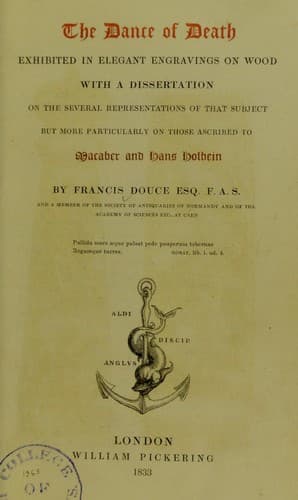
The Dance of Death: Exhibited in Elegant Engravings on Wood with a Dissertation on the Several Representations of that Subject but More Particularly on Those Ascribed to Macaber and Hans HolbeinDouce, Francis
History
The Dance of Death: Exhibited in Elegant Engravings on Wood with a Dissertation on the Several Representations of that Subject but More Particularly on Those Ascribed to Macaber and Hans Holbein
Douce, Francis
Bible. Old Testament -- Illustrations; Dance of death
In the absence of positive evidence it may surely be allowed to substitute
probable conjecture; and as it cannot be clearly proved that Holbein
painted a Dance of Death at Basle, may not the before-mentioned verses of
Borbonius refer to his painting at Whitehall, and which the poet must
himself have seen? It is no objection that Borbonius remained a year only
in England, when his portrait was painted by his friend Holbein in 1535,
or that the verses did not make their appearance till 1538, for they seem
rather to fix the date of the painting, if really belonging to it, between
those years; and it is not unreasonable to suppose that Borbonius would
hold some intercourse with the painter, even after leaving England, as is
indeed apparent from other compliments bestowed on him in his Nugæ, the
contents of which are by no means chronologically arranged, and many of
the poems known to have been written long before their publication. The
lines in question might have been written any where, and at any time, and
this may be very safely stated until the real time in which the Whitehall
painting was made shall be ascertained.
In one of Vanderdort's manuscript catalogues of the pictures and rarities
transported from St. James's to Whitehall, and placed there in the newly
erected cabinet room of Charles I. and in which several works by Holbein
are mentioned, there is the following article: "A little piece where Death
with a green garland about his head, stretching both his arms to apprehend
a Pilate in the habit of one of the spiritual Prince Electors of Germany.
Copied by Isaac Oliver from Holbein."[130] There cannot be a doubt that
this refers to the subject of the Elector, as painted by Holbein in the
Dance of Death at Whitehall, proving at the same time the identity of the
painting with the wood-cuts, whatever may be the inference.
Sandrart, after noticing a remarkable portrait of Henry VIII. at
Whitehall, states, that "there yet remains in that palace _another work_
by Holbein that constitutes him the Apelles of the time."[131] This is
certainly very like an allusion to a Dance of Death.
It is by no means improbable that Mathew Prior may have alluded to
Holbein's painting at Whitehall, as it is not likely that he would be
acquainted with any other.
Our term of life depends not on our deed,
Before our birth our funeral was decreed,
Nor aw'd by foresight, nor misled by chance,
Imperious death directs the ebon lance,
Peoples great Henry's tombs, and leads up Holbein's Dance.
_Ode to the Memory of George Villiers._
CHAPTER X.
_Other Dances of Death._
Having thus disposed of the two most ancient and important works on the
subject in question, others of a similar nature, but with designs
altogether different, and introduced into various books, remain to be
noticed, and such are the following:
Public-domain text, read in full here on John Shaqi.
Reviews
Reviews
No reviews yet
Be the first to share your thoughts on this work.
Elsewhere in the archive
Join the Discussion
Join the discussion
Sign in to leave a comment or review.
Sign InorCreate an account