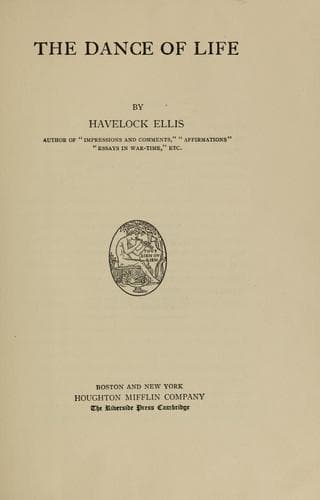
Conduct of life; English essays -- 20th century; Ethics; Philosophy
But in nature and among primitive peoples it has its value precisely on
this account. It is a process of courtship and, even more than that, it
is a novitiate for love, and a novitiate which was found to be an
admirable training for love. Among some peoples, indeed, as the Omahas,
the same word meant both to dance and to love. By his beauty, his
energy, his skill, the male must win the female, so impressing the image
of himself on her imagination that finally her desire is aroused to
overcome her reticence. That is the task of the male throughout nature,
and in innumerable species besides Man it has been found that the school
in which the task may best be learnt is the dancing-school. Those who
have not the skill and the strength to learn are left behind, and, as
they are probably the least capable members of the race, it may be in
this way that a kind of sexual selection has been embodied in
unconscious eugenics, and aided the higher development of the race. The
moths and the butterflies, the African ostrich and the Sumatran argus
pheasant, with their fellows innumerable, have been the precursors of
man in the strenuous school of erotic dancing, fitting themselves for
selection by the females of their choice as the most splendid
progenitors of the future race.[19]
From this point of view, it is clear, the dance performed a double
function. On the one hand, the tendency to dance, arising under the
obscure stress of this impulse, brought out the best possibilities the
individual held the promise of; on the other hand, at the moment of
courtship, the display of the activities thus acquired developed on the
sensory side all the latent possibilities of beauty which at last became
conscious in man. That this came about we cannot easily escape
concluding. How it came about, how it happens that some of the least
intelligent of creatures thus developed a beauty and a grace that are
enchanting even to our human eyes, is a miracle, even if not affected by
the mystery of sex, which we cannot yet comprehend.
When we survey the human world, the erotic dance of the animal world is
seen not to have lost, but rather to have gained, influence. It is no
longer the males alone who are thus competing for the love of the
females. It comes about by a modification in the earlier method of
selection that often not only the men dance for the women, but the women
for the men, each striving in a storm of rivalry to arouse and attract
the desire of the other. In innumerable parts of the world the season of
love is a time which the nubile of each sex devote to dancing in each
other’s presence, sometimes one sex, sometimes the other, sometimes
both, in the frantic effort to display all the force and energy, the
skill and endurance, the beauty and grace, which at this moment are
yearning within them to be poured into the stream of the race’s life.
Public-domain text, read in full here on John Shaqi.
Reviews
Reviews
No reviews yet
Be the first to share your thoughts on this work.
Join the Discussion
Join the discussion
Sign in to leave a comment or review.
Sign InorCreate an account