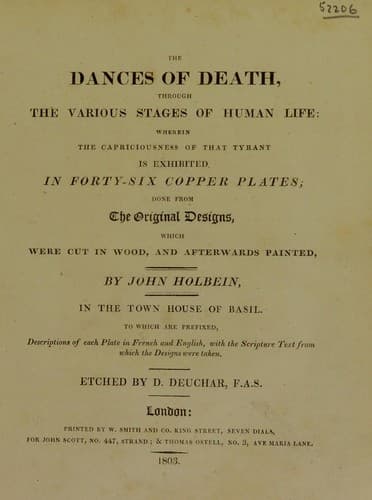
The Dances of Death: Through the Various Stages of Human Life: Wherein the Capriciousness of that Tyrant is Exhibited
Philosophy
The Dances of Death: Through the Various Stages of Human Life: Wherein the Capriciousness of that Tyrant is Exhibited
Dance of death; Dance of death in art
PLANCHE XXIII.—LES NOUVEAUX MARIES.
Dans les premiers transports d’une douce union, ces deux tendres époux
paroissent tellement occupés l’un de l’autre, ils sont si enivrés de leur
bonheur mutuel, qu’ils ne voient ni n’entendent la Mort qui marche devant
eux, en frappant vigoureusement sur un petit tambour, & qui va leur
donner bientôt un cruel trouble-fête.
PLATE XXIV.—THE CANONESS.
There appears in this young and beautiful recluse, a striking mixture
of gallantry and devotion. On her knees before a little altar, with her
rosary in her hand, she is amorously listening to the songs which a young
man, seated on a bed, addresses to her, accompanying them with his lute.
Death comes to put out the tapers burning on the altar, and to change
into sadness the pleasures of this conversation.
[Illustration: _Est via, quæ videtur homini justa: novissima autem ejus
deducunt hominem ad mortem. Prov. xiv. 12._]
PLANCHE XXIV.—LA CHANOINESSE.
L’on voit dans cette jeune & belle recluse un mélange frappant de
galanterie & de dévotion. Agenouillée devant un petit autel, son rosaire
à la main, elle écoute amoureusement les chansons qu’un jeune homme,
assis sur son lit, lui adresse en les accompagnant de son luth. La Mort
vient éteindre les cierges allumés sur l’autel, & changer en amertume les
douceurs de ce tête-à-tête.
PLATE XXV.—THE COUNT.
Death here adds to his usual employment that of avenger of oppressed
vassals. He is throwing with violence at the head of this Lord, his
coat of arms, the dear object of his pride, under the weight of which
he is ready to make him fall. He appears trampling under foot a flail,
to mark his inhumanity to labourers, a class of society so necessary
and respectable. On the ground also are to be seen the remains of the
helmet which formed the crest of his arms, with the other ornaments that
decorated them.
[Illustration: _Quoniam cum interierit, non sumet omnia: neque descendet
cum eo gloria ejus. Psal. xlvii. 18._]
PLANCHE XXV.—LE COMTE.
La Mort ajoute ici à l’exercice de son emploi accoutumé celui de vengeur
de vassaux opprimés; elle jette avec violence à la tête de ce Seigneur
ses armoiries, l’objet chéri de son orgueil, sous le poids desquelles
elle va le faire périr. On le voit fouler à ses pieds un fléau, pour
désigner son inhumanité envers les laboureurs, cette classe de la société
si nécessaire & si respectable; on peut encore remarquer à terre, les
débris du casque dont ces armoiries étoient surmontées avec d’autres
ornemens qui les décoroient.
PLATE XXVI.—THE KNIGHT.
This worthy Cavalier, returned victorious from so many combats and
tournaments, comes at length to meet his match. Death has run him through
the body with a furious stroke of the lance, and is laughing at the vain
efforts he makes to defend himself.
[Illustration: _Subito morientur, & in media nocte turbabuntur populi, &
auferent violentum absque manu. Job xxxiv. 20._]
PLANCHE XXVI.—LE CHEVALIER.
Public-domain text, read in full here on John Shaqi.
Reviews
Reviews
No reviews yet
Be the first to share your thoughts on this work.
Join the Discussion
Join the discussion
Sign in to leave a comment or review.
Sign InorCreate an account