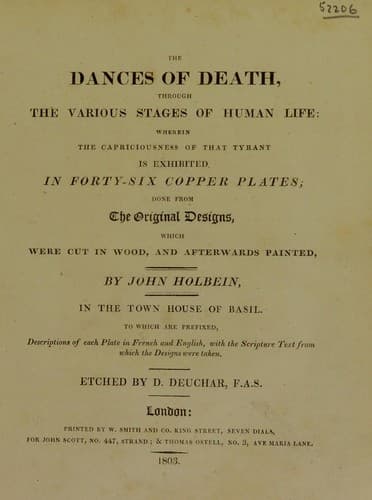
The Dances of Death: Through the Various Stages of Human Life: Wherein the Capriciousness of that Tyrant is Exhibited — John Shaqi
The Dances of Death: Through the Various Stages of Human Life: Wherein the Capriciousness of that Tyrant is Exhibited
Philosophy
The Dances of Death: Through the Various Stages of Human Life: Wherein the Capriciousness of that Tyrant is Exhibited
Dance of death; Dance of death in art
The genius and excellence of this master were sufficiently shewn in the
historical style, by two celebrated compositions which he painted in the
Hall of the Steel-yard Company; of which the subjects were the Triumph of
Riches, and the condition of Poverty: these two are universally admired
for the richness of the colouring, as also for the strong character
of the figures through the whole. Frederick Zucchero, on seeing these
pictures, expressed the highest esteem for Holbein, and even copied them
in Indian ink.
In the town of Basil he painted a picture of our Saviour’s Sufferings, as
well as a Dance of Peasants.
Abbé du Bos observes, that the altar-piece at Basil, painted by Holbein,
may be compared with the best productions of Raphael’s disciples for
composition, and preferred to them with respect to colouring; that he
shews a greater degree of knowledge of the chiaro-scuro, and particular
incidents of light that are truly marvellous. But that which contributed
most to raise and establish the reputation of this celebrated Painter was
Death’s Dance, designed and painted by him in the town-house of Basil; a
work truly admirable, and which alone was sufficient to render the name
of Holbein immortal.
Sandrart relates, that he heard Rubens acknowledge, that he had learned
a great deal from the pictures of Death’s Dance; and he recommended them
strongly to the study of many of his own profession.
The learned Erasmus was so much struck by the wonderful display of genius
exhibited in this great work, that he conceived a strong friendship
for Holbein; sat to him for his picture; and recommended him to Sir
Thomas Moore, the then Lord Chancellor of England: and to this incident
our country is indebted for the many excellent performances which it
afterwards received from the pencil of Holbein.
The designs for Death’s Dance were cut in wood by Holbein, and published
with the original texts from which they were taken; from that work the
following plates were done. They contain the whole of Death’s Dance, with
borders and decorations; to which are added, a description of each plate
in French and English, and a portrait of Holbein.
[Illustration: _CREATIO MUNDI_
_Formauit Dominus DEUS hominem de limo terræ, ad imaginem suam creauit
illum, masculum & fæminam creauit eos. GEN. I. & II._]
[Illustration]
EXPLANATIONS
OF
THE SUBJECTS
OF
_THE TRIUMPH OF DEATH_,
BY HANS HOLBEIN.
PLATE I.—FRONTISPIECE.
Public-domain text, read in full here on John Shaqi.
Reviews
Reviews
No reviews yet
Be the first to share your thoughts on this work.
Join the Discussion
Join the discussion
Sign in to leave a comment or review.
Sign InorCreate an account