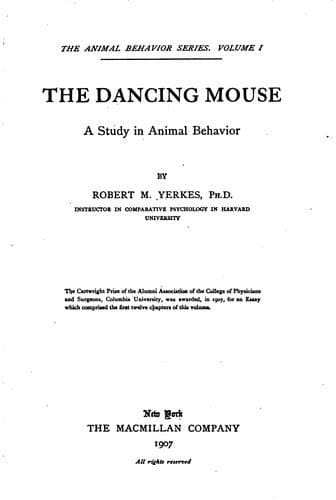
The Dancing Mouse: A Study in Animal BehaviorYerkes, Robert Mearns
Science
The Dancing Mouse: A Study in Animal Behavior
Yerkes, Robert Mearns
Animal behavior; Dancing mice
Under the direction of Professor G. H. Parker, Doctor Karl Waugh has
examined the structure of the retina of the dancing mouse for me, with the
result that only a single type of retinal element was discovered.
Apparently the animals possess rod-like cells, but nothing closely similar
to the cones of the typical mammalian retina. This is of peculiar interest
and importance in connection with the results which I have reported in the
foregoing pages, because the rods are supposed to have to do with
brightness or luminosity vision and the cones with color vision. In fact,
it is usually supposed that the absence of cones in the mammalian retina
indicates the lack of color vision. That this inference of functional
facts from structural conditions is correct I am by no means certain, but
at any rate all of the experiments which I have made to determine the
visual ability of the dancer go to show that color vision, if it exists at
all, is extremely poor. It is gratifying indeed to learn, after such a
study of behavior as has just been described, that the structural
conditions, so far as we are able to judge at present, justify the
conclusions which have been drawn.
CHAPTER XI
THE ROLE OF SIGHT IN THE DAILY LIFE OF THE DANCER
Darting hither and thither in its cage, whirling rapidly, now to the left,
now to the right, running in circles, passing through holes in the nest
box quickly and neatly, the dancer, it would seem, must have excellent
sight. But careful observation of its behavior modifies this inference.
For it appears that a pair of mice dancing together, or near one another,
sometimes collide, and that it is only those holes with which the animal
is familiar that are entered skillfully. In fact, the longer one observes
the behavior of the dancer under natural conditions, the more he comes to
believe in the importance of touch, and motor tendencies. Sight, which at
first appears to be the chief guiding sense, comes to take a secondary
place. In this chapter it is my purpose to show by means of simple
experiments what part sight plays in the dancer's life of habit formation.
The evidence on this subject has been obtained from four sources: (1)
observation of the behavior of dancers in their cages; (2) observation of
their behavior when blinded; (3) observation of their behavior in a great
variety of discrimination experiments, many of which have already been
described; and (4) observation of their behavior in labyrinth experiments
which were especially planned to exhibit the importance of the several
kinds of vision which the dancer might be supposed to possess. The
evidence from the first three of these sources may be presented summarily,
for much of it has already appeared in earlier chapters. That from the
fourth source will constitute the bulk of the material of this chapter.
Public-domain text, read in full here on John Shaqi.
Reviews
Reviews
No reviews yet
Be the first to share your thoughts on this work.
Elsewhere in the archive
Join the Discussion
Join the discussion
Sign in to leave a comment or review.
Sign InorCreate an account