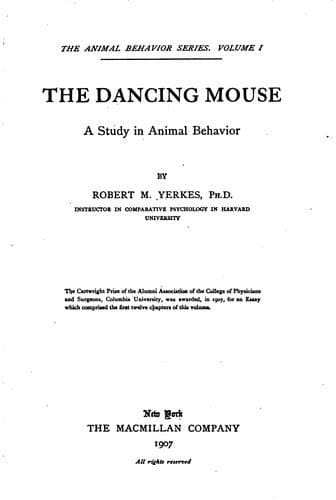
The Dancing Mouse: A Study in Animal BehaviorYerkes, Robert Mearns
Science
The Dancing Mouse: A Study in Animal Behavior
Yerkes, Robert Mearns
Animal behavior; Dancing mice
My observation of the behavior of the mice has furnished conclusive
evidence of their ability to see moving objects. But that they do not see
very distinctly, and that they do not have accurate perception of the form
of objects, are conclusions which are supported by observations that I
have made under both natural and experimental conditions. In Chapters VII,
VIII, IX, and X, I have presented an abundance of evidence of brightness
vision and, in addition, indications of a specific sensitiveness to wave
length which may be said to correspond to our color vision. It is
noteworthy, however, that all of the experimental proofs of visual ability
were obtained as the result of long periods of training. Seldom, indeed,
in my experience with them, have the dancers under natural conditions
exhibited forms of activity which were unquestionably guided by vision.
It is claimed by those who have experimented with blinded dancers that the
loss of sight decreases the amount and rapidity of movement, and the
ability of the animals to avoid obstacles.
By means of the discrimination method previously used in the preliminary
experiments on color vision, a full description of which may be found in
Chapter IX, p. 133, the dancers' ability to perceive form was tested.
Immediately after the two males _A_ and _B_ had been given the "food-box"
tests, whose results appear in Table 15, they were tested in the same
apparatus and by the same method for their ability to discriminate a
rectangular food-box from a round one. In the case of the color
discrimination tests, it will be remembered that the circular tin boxes 5
cm. in diameter by 1.5 cm. in depth, one of which was covered with blue
paper, the other with orange, were used. For the form discrimination tests
I used instead one of the circular boxes of the dimensions given above and
a rectangular box 8.5 cm. long, 5.5 cm. wide and 2.5 cm. deep. "Force" was
placed in the circular box. The tests were given, in series of 20, daily.
TABLE 30
VISUAL FORM TESTS
Public-domain text, read in full here on John Shaqi.
Reviews
Reviews
No reviews yet
Be the first to share your thoughts on this work.
Elsewhere in the archive
Join the Discussion
Join the discussion
Sign in to leave a comment or review.
Sign InorCreate an account