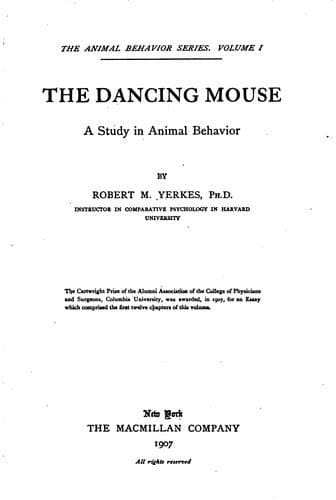
The Dancing Mouse: A Study in Animal BehaviorYerkes, Robert Mearns
Science
The Dancing Mouse: A Study in Animal Behavior
Yerkes, Robert Mearns
Animal behavior; Dancing mice
To this evidence of a lack of an imitative tendency in the dancer I may
here add the results of my observations in other experiments. In the
discrimination tests and in the labyrinth tests I purposely so arranged
conditions, in certain instances, that one individual should have an
opportunity to imitate another. In no case did this occur. Seldom indeed
did the animals so much as follow one another with any considerable degree
of persistence. They did not profit by one another's acts.
Excellent evidence in support of this conclusion was furnished by the
behavior of the mice in the discrimination experiments. Some individuals
learned to pull as well as to push the swinging wire doors of the
apparatus and were thus enabled to pass through the doorways in either
direction; other individuals learned only to pass through in the direction
in which the doors could be pushed open. Naturally I was interested to
discover whether those which knew only the trick of opening the doors by
pushing would learn to pull the doors or would be stimulated to try by
seeing other individuals do so. At first I arranged special tests of
imitation in the discrimination box; later I observed the influence of the
behavior of one mouse upon that of its companion in connection with visual
discrimination experiments. This was made possible by the fact that
usually a pair of individuals was placed in the discrimination box and the
tests given alternately to the male and to the female. Both individuals
had the freedom of the nest-box and each frequently saw the other pass
through the doorway between the nest-box, _A_, and the entrance chamber,
_B_ (Figure 14), either from _A_ to _B_ by pushing the swing door or from
_B_ to _A_ by pulling the door.
Although abundant opportunity for imitation in connection with the opening
of the doors in the discrimination box was given to twenty-five
individuals, I obtained no evidence of ability to learn by imitation. The
dancers did not watch the acts which were performed by their companions,
and in most instances they did not attempt to follow a mate from nest-box
to entrance chamber.
These problem tests, simple as they are, have revealed two important facts
concerning the educability of the dancer. First, that it does not learn by
imitation to any considerable extent, and, second, that it is aided by
being put through an act. Our general conclusion from the results of the
experiments which have been described in this chapter, if any general
conclusion is to be drawn thus prematurely, must be that the dancing mouse
in its methods of learning differs markedly from other mice and from rats.
CHAPTER XIII
HABIT FORMATION: THE LABYRINTH HABIT
Public-domain text, read in full here on John Shaqi.
Reviews
Reviews
No reviews yet
Be the first to share your thoughts on this work.
Elsewhere in the archive
Join the Discussion
Join the discussion
Sign in to leave a comment or review.
Sign InorCreate an account