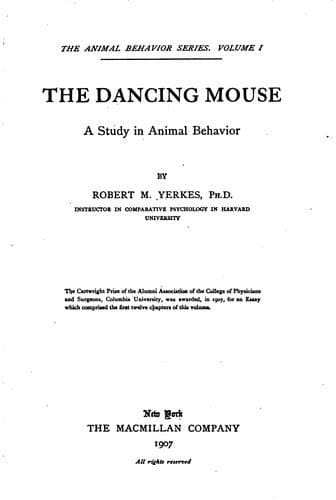
The Dancing Mouse: A Study in Animal BehaviorYerkes, Robert Mearns
Science
The Dancing Mouse: A Study in Animal Behavior
Yerkes, Robert Mearns
Animal behavior; Dancing mice
That there are marked individual differences in intelligence in the
dancing mice is apparent from the results of the ladder-climbing
experiment. No. 1000 learned to climb quickly, and largely by his own
initiative; Nos. 2 and 6, on the contrary, learned only by reason of
tuition (being put through the required act by the experimenter). It
occurred to me that this experiment, since it was difficult for some
individuals and easy for others, might be used to advantage as a test of
imitation. If a dancer which knows how to escape to the cage by way of the
ladder be placed in the wooden box with one which, despite abundant
opportunity, has proved unable to form the habit on his own initiative,
will the latter profit by the activity of the former and thus learn the
method of escape?
On November 20, Nos. 4 and 5 were placed in the wooden box and left there
for half an hour. As they had failed to escape at the end of this
interval, they were taken out of the box by the experimenter and returned
to the nest-box. November 21 and 22 this test of their ability to learn to
climb the ladder was repeated with the same result. On November 23 they
were placed in the box with the three mice which had previously been
trained to climb the ladder. The latter escaped at once. Apparently the
attention of Nos. 4 and 5 was drawn to the ladder by the disappearance of
their companions, for they approached its foot and No. 5 climbed up a
short distance. Neither succeeded in escaping, however, and they made no
further efforts that day. On the 24th, and daily thereafter until the
29th, these two dancers were placed in the box for half an hour, with
negative results. At the end of the half hour on the 29th, Nos. 2 and 6
were placed in the box and permitted to go back and forth from one box to
the other repeatedly within sight of Nos. 4 and 5. The latter made no
attempts to follow them, although at times they seemed to be watching
their movements as they ascended the ladder.
To render the results of this test of imitation still more conclusive No.
5 was given further opportunity to learn from No. 1000. Beginning December
2, the following method of experimentation was employed with these two
individuals. They were placed in the wooden box together. No. 1000 usually
climbed out almost immediately. Sometimes No. 5 apparently saw him
disappear up the ladder; sometimes she paid no attention whatever either
to the presence or absence of her companion. After he had been in the
nest-box for a few seconds, No. 1000 was returned to the wooden box by the
experimenter and again permitted to climb out for the benefit of No. 5.
This mode of procedure was kept up until No. 1000 had made from three to
ten trips. No. 5 was left in the box for half an hour each day. This test
was repeated on 18 days within a period of 3 weeks. No. 5 showed no signs
of an imitative tendency, and she did not learn to climb the ladder.
Public-domain text, read in full here on John Shaqi.
Reviews
Reviews
No reviews yet
Be the first to share your thoughts on this work.
Elsewhere in the archive
Join the Discussion
Join the discussion
Sign in to leave a comment or review.
Sign InorCreate an account