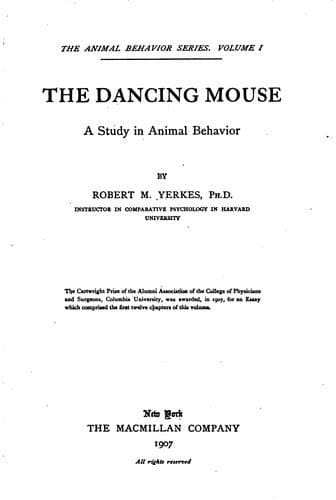
The Dancing Mouse: A Study in Animal BehaviorYerkes, Robert Mearns
Science
The Dancing Mouse: A Study in Animal Behavior
Yerkes, Robert Mearns
Animal behavior; Dancing mice
On the basis of two tests per day, two common mice, a white one and a gray
one, quickly learned to escape from labyrinth _A_ by the shortest path.
The time of escape for the gray individual (Table 37) decreased from 180"
in the first test to 21" in the tenth, and the number of errors from 6 to
1. Similarly in the case of the white individual, the time decreased from
122" to 8", and the errors from 5 to 1. A fraction of the number of tests
to which the dancer had been subjected sufficed to establish a habit of
escape in the common mouse. It is evident, therefore, that the dancer
differs radically from the common mouse in its behavior in a maze, and it
is also clear that the labyrinth method, if it is to be used to advantage,
must be adapted to the motor tendencies of the animal which is to be
tested.
TABLE 37
RESULTS OF LABYRINTH A TESTS WITH COMMON MICE
GREY MOUSE WHITE MOUSE
TEST T E T E
1 180" 6 122" 5
2 26 2 80 6
3 37 1 56 4
4 18 0 27 1
5 68 2 33 2
6 10 1 19 1
7 11 1 17 1
8 13 1 17 1
9 10 0 8 1
10 21 1 8 1
The behavior of the dancer made obvious two defects in labyrinth A. Its
passages are so large that the mouse is constantly tempted to dance, and
it lacks the basis for a strong and constant motive of escape by the
direct path. To obviate these shortcomings labyrinth B was constructed, as
is shown in Figures 23 and 24, with very narrow passages, and a floor
which was covered with the wires of an interrupted electric circuit so
that errors might be punished. The length of this labyrinth was 52 cm. and
the passages were 2.5 cm. wide and 10 cm. deep. Dancing in these narrow
alleys was practically impossible, for the mice could barely turn around
in them. In the case of all except the common mice and two dancers, a
depth of 10 cm. was sufficient to keep the animals in the maze without the
use of a cover.
As an account of the behavior of the dancer in labyrinth B has already
been given in Chapter XI, I may now state the general results of the
experiments. In all, thirty individuals were trained in this labyrinth.
Each individual was given tests at the rate of one per minute until it had
succeeded in following the correct path five times in succession. The weak
electric shock, which was given as a punishment for mistakes, provided an
activity-impelling motive for escape to the nest-box.
Public-domain text, read in full here on John Shaqi.
Reviews
Reviews
No reviews yet
Be the first to share your thoughts on this work.
Elsewhere in the archive
Join the Discussion
Join the discussion
Sign in to leave a comment or review.
Sign InorCreate an account