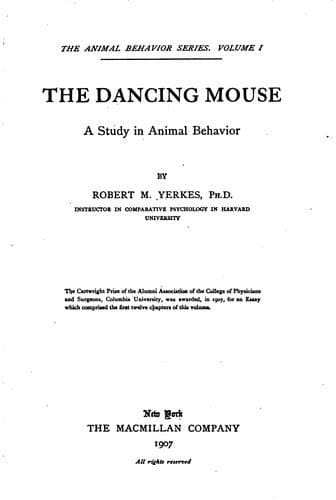
The Dancing Mouse: A Study in Animal BehaviorYerkes, Robert Mearns
Science
The Dancing Mouse: A Study in Animal Behavior
Yerkes, Robert Mearns
Animal behavior; Dancing mice
there is seldom any hesitation at the turning points. The irregular
labyrinth is followed carefully, as by choice of the path from point to
point; the regular labyrinth is followed in machine fashion,--once
started, the animal dashes through it.
TABLE 40
RESULTS OF LABYRINTH-D EXPERIMENTS, WITH TWENTY DANCERS
MALES FEMALES
NO. OF NO. OF FIRST NO. OF LAST OF NO. OF NO. OF FIRST NO. OF LAST OF
MOUSE CORRECT TWO CORRECT MOUSE CORRECT TWO CORRECT
TEST TESTS TEST TESTS
2 3 7 29 10 11
58 7 10 49 7 8
30 9 10 57 3 6
60 10 14 215 6 10
402 10 11 415 7 8
76 4 7 75 4 13
78 4 5 77 11 12
86 3 9 87 4 9
88 4 8 85 3 4
90 7 8 83 4 7
Av. 6.1 8.9 Av. 5.9 8.8
From the results of these labyrinth experiments with dancers I am led to
conclude that a standard maze for testing the modifiability of behavior of
different kinds of animals should be constructed in conformity with the
following suggestions. Errors by turning to the right, to the left, and by
moving forward should occur with equal frequency, and in such order that
no particular kind of error occurs repeatedly in succession. If we should
designate these three types of mistake by the letters _r, l_, and _s_
respectively, the error series of labyrinth C would read _l-l-r-s-l_. It
therefore violates the rule of construction which I have just formulated.
In the case of labyrinth D the series would read _l-s-r-s-l-s-r-s-l-s-r-s-
l_. This also fails to conform with the requirement, for there are three
errors of the first type, four of the second, and six of the third. Again,
in a standard maze, the blind alleys should all be of the same length, and
care should be taken to provide a sufficiently strong and uniform motive
for escape. In the case of one animal the desire to escape from
confinement may prove a satisfactory motive; in the case of another, the
desire for food may conveniently supplement the dislike of confinement;
and in still other cases it may appear that some form of punishment for
errors is the only satisfactory basis of a motive for escape. Readers of
this account of the behavior of the dancing mouse must not infer from my
experimental results that the electric shock as a means of forcing
discrimination will prove satisfactory in work with other animals or even
with all other mammals. As a matter of fact it has already been proved by
Doctor G.
Public-domain text, read in full here on John Shaqi.
Reviews
Reviews
No reviews yet
Be the first to share your thoughts on this work.
Elsewhere in the archive
Join the Discussion
Join the discussion
Sign in to leave a comment or review.
Sign InorCreate an account