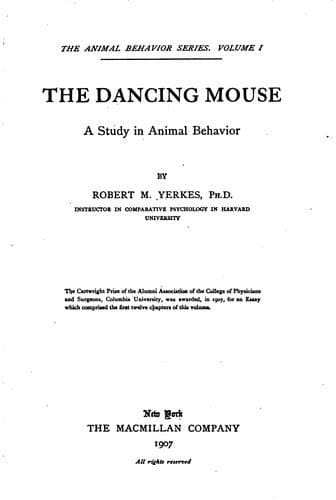
The Dancing Mouse: A Study in Animal BehaviorYerkes, Robert Mearns
Science
The Dancing Mouse: A Study in Animal Behavior
Yerkes, Robert Mearns
Animal behavior; Dancing mice
van T. Hamilton that the use of an electric shock may so
intimidate a dog that experimentation is rendered difficult and of little
value. And finally, in connection with this discussion of a standard
Labyrinth, I wish to emphasize the importance of so recording the results
of experiments that they may be interpreted in terms of an animal's
tendency to turn to the right or to the left. My work with the dancer has
clearly shown that the avoidance of a particular error may be extremely
difficult for left whirlers and very easy for right whirlers.
I hope I have succeeded in making clear by the foregoing account of my
experiments that the labyrinth method is more satisfactory in general than
the problem method as a means of measuring the rapidity of habit formation
in the dancer, and I hope that I have made equally clear the fact that it
is very valuable as a means of discovering the roles of the various senses
in the acquirement of a habit (Chapter XI). From my own experience in the
use of the labyrinth with the dancer and with other animals, I am forced
to conclude that its chief value lies in the fact that it enables the
experimenter so to control the factors of a complex situation that he may
readily determine the importance of a given kind of sense data for the
formation or the execution of a particular habit. As a means of measuring
the intelligence of an animal, of determining the facility with which it
is capable of adjusting itself to new environmental conditions, and of
measuring the permanency of modifications which are wrought in its
behavior by experimental conditions, I value the labyrinth method much
less highly now than I did previous to my study of the dancer. It is
necessarily too complex for the convenient and reasonably certain
interpretation of results. Precisely what is meant by this statement will
be evident in the light of the results of the application of the
discrimination method to the dancer, which are to be presented in the next
chapter. The labyrinth method is an admirable means of getting certain
kinds of qualitative results; it is almost ideal as a revealer of the role
of the senses, and it may be used to advantage in certain instances for
the quantitative study of habit formation and memory. Nevertheless, I
think it may safely be said that the problem method and the discrimination
method are likely to do more to advance our knowledge of animal behavior
than the labyrinth method.
CHAPTER XIV
HABIT FORMATION: THE DISCRIMINATION METHOD
Discrimination is demanded of an animal in almost all forms of the problem
and labyrinth methods, as well as in what I have chosen to call the
discrimination method. In the latter, however, discrimination as the basis
of a correct choice of an electric-box is so obviously important that it
has seemed appropriate to distinguish this particular method of measuring
the intelligence of the dancer from the others which have been used, by
naming it the discrimination method.
Public-domain text, read in full here on John Shaqi.
Reviews
Reviews
No reviews yet
Be the first to share your thoughts on this work.
Elsewhere in the archive
Join the Discussion
Join the discussion
Sign in to leave a comment or review.
Sign InorCreate an account