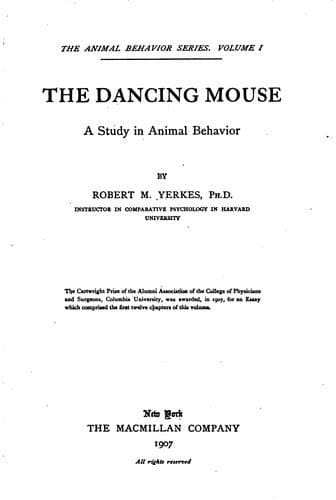
The Dancing Mouse: A Study in Animal BehaviorYerkes, Robert Mearns
Science
The Dancing Mouse: A Study in Animal Behavior
Yerkes, Robert Mearns
Animal behavior; Dancing mice
The form of the discrimination method whose results are to be presented in
this chapter has already been described as white-black discrimination. In
the discrimination box (Figures 14 and 15, p. 92) the two electric-boxes
which were otherwise exactly alike in appearance were rendered
discriminable for the mouse by the presence of white cardboards in one and
black cardboards in the other. In order to escape from the narrow space
before the entrances to the two electric-boxes, the dancer was required to
enter the white box. If it entered the black box a weak electric shock was
experienced. After two series of ten tests each, during which the animal
was permitted to choose either the white or the black box without shock or
hindrance, the training was begun. These two preliminary series serve to
indicate the natural preference of the animal for white or black previous
to the training. An individual which very strongly preferred the white
might enter, from the first, the box thus distinguished, whereas another
individual whose preference was for the black might persistently enter the
black box in spite of the disagreeable shocks. First of all, therefore,
the preliminary tests furnish a basis for the evaluation of the results of
the subsequent training tests. On the day succeeding the last series of
preliminary tests, and daily thereafter until the animal had acquired a
perfect habit of choosing the white box, a series of training tests was
given. These experiments were usually made in the morning between nine and
twelve o'clock, in a room with south-east windows. The entrances to the
electric-boxes faced the windows, consequently the mouse did not have to
look toward the light when it was trying to discriminate white from black.
All the conditions of the experiment, including the strength of the
current for the shock, were kept as constant as possible.
Choice by position was effectively prevented, as a rule, by shifting the
cardboards so that now the left now the right box was white. The order of
these shifts for the white-black series whose results are quantitatively
valuable appear in Table 12 (p. III). That the order of these changes in
position may be criticised in the light of the results which the tests
gave, I propose to show hereafter in connection with certain other facts.
The significant point is that the defects which are indicated by the
averages of thousands of tests could not have been predicted with
certainty even by the most experienced investigator in this field.
Public-domain text, read in full here on John Shaqi.
Reviews
Reviews
No reviews yet
Be the first to share your thoughts on this work.
Elsewhere in the archive
Join the Discussion
Join the discussion
Sign in to leave a comment or review.
Sign InorCreate an account