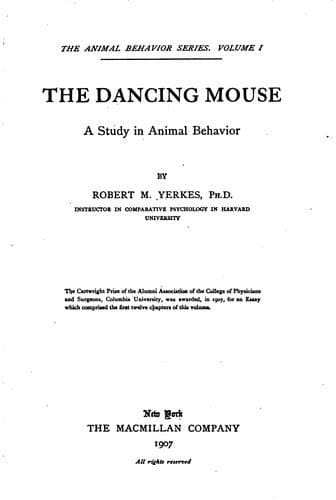
The Dancing Mouse: A Study in Animal BehaviorYerkes, Robert Mearns
Science
The Dancing Mouse: A Study in Animal Behavior
Yerkes, Robert Mearns
Animal behavior; Dancing mice
It has been shown that neither the problem nor the labyrinth method proves
wholly satisfactory as a means of measuring the rapidity of learning, or
the duration of the effects of training, in the case of the dancer. The
former type of test serves to reveal to the experimenter the general
nature of the animal's capacity for profiting by experience; the latter
serves equally well to indicate the parts which various receptors (some of
which are sense organs) play in the formation and execution of habits. But
neither of them is sufficiently simple, easy of control, uniform as to
conditions which constitute bases for activity, and productive of
interpretable quantitative results to render it satisfactory. The problem
method is distinctly a qualitative method, and, in the case of the dancing
mouse, my experiments have proved that the labyrinth method also yields
results which are more valuable qualitatively than quantitatively. I had
anticipated that various forms of the labyrinth method would enable me to
measure the modifiability of behavior in the dancer with great accuracy,
but, as will now be made apparent, the discrimination method proved to be
a far more accurate method for this purpose.
Once more I should emphasize the fact that my statements concerning the
value of methods apply especially to the dancing mouse. Certain of the
tests which have proved to be almost ideal in my study of this peculiar
little rodent would be useless in the study of many other mammals. An
experimenter must work out his methods step by step in the light of the
daily results of patient and intelligent observation of the motor
capacity, habits, instincts, temperament, imitative tendency,
intelligence, hardihood, and life-span of the animal which he is studying.
The fact that punishment has proved to be more satisfactory than reward in
experiments with the dancer does not justify the inference that it is more
satisfactory in the case of the rat, cat, dog, or monkey. Methods which
yielded me only qualitative results, if applied to other mammals might
give accurate quantitative results; and, on the other hand, the
discrimination method, which has proved invaluable for my quantitative
work, might yield only qualitative results when applied to another kind of
animal.
Public-domain text, read in full here on John Shaqi.
Reviews
Reviews
No reviews yet
Be the first to share your thoughts on this work.
Elsewhere in the archive
Join the Discussion
Join the discussion
Sign in to leave a comment or review.
Sign InorCreate an account