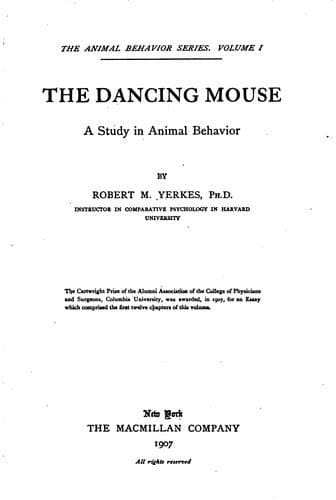
The Dancing Mouse: A Study in Animal BehaviorYerkes, Robert Mearns
Science
The Dancing Mouse: A Study in Animal Behavior
Yerkes, Robert Mearns
Animal behavior; Dancing mice
As an indication of the degree of accuracy of measurements of the rapidity
of learning which are obtained by the use of 5 individuals I may offer the
following figures. For one of two directly comparable groups of 5 male
dancers which were chosen from 16 individuals which had been trained, the
number of tests which resulted in a perfect habit of white-black
discrimination was 92; for the other group it was 96. These indices for
strictly comparable groups of 5 individuals each differ from one another
by less than 5 per cent. Similarly, in the case of two groups of females,
the indices of modifiability were 94 and 104. These figures designate the
number of tests up to the point at which errors ceased for at least three
successive series (30 tests).
The determination of the probable error of the index of modifiability
further aids us in judging of the reliability of the measure of the
rapidity of learning which is obtained by averaging the results for 5
individuals. For a group of 5 males (Table 43, p. 243) the index was 72 ±
3.5; and for a group of 5 females of the same age as the males and
strictly comparable with respect to conditions of white-black training, it
was 104 ± 2.9. A probable error of ± 3.5 indicates the reliability of the
first of these indices of modifiability; one of ± 2.9, that of the second.
I do not doubt that 10 individuals would furnish a more reliable average
than 5, but I do doubt whether the purposes of my experiments would have
justified the great increase in work which the use of averages based upon
so large a group would have necessitated.
Further discussion of the index of modifiability may be postponed until
the several indices which serve as measures of the efficiency of different
methods of training have been presented in the next chapter.
From the data which constitute the materials of the present chapter it is
apparent that the results of the discrimination method are amenable to
much more accurate quantitative treatment than are those of the problem
method or the labyrinth method. But I have done little more as yet than
describe the method by which it is possible to measure certain dimensions
of the intelligence of the dancer, and to state some general results of
its application. In the remaining chapters it will be our task to discover
the value of this method and of the results which it has yielded.
CHAPTER XV
THE EFFICIENCY OF TRAINING METHODS
The nature of the modifications which are wrought in the behavior of an
organism varies with the method of training. This fact is recognized by
human educators, as well as by students of animal behavior (makers of the
science of comparative pedagogy), but unfortunately accurate measurements
of the efficiency of our educational methods are rare.
Public-domain text, read in full here on John Shaqi.
Reviews
Reviews
No reviews yet
Be the first to share your thoughts on this work.
Elsewhere in the archive
Join the Discussion
Join the discussion
Sign in to leave a comment or review.
Sign InorCreate an account