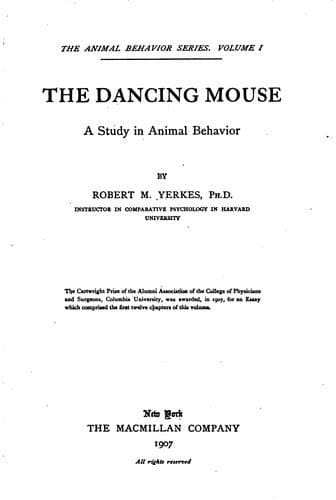
The Dancing Mouse: A Study in Animal BehaviorYerkes, Robert Mearns
Science
The Dancing Mouse: A Study in Animal Behavior
Yerkes, Robert Mearns
Animal behavior; Dancing mice
Whatever the subject of investigation, there are two preeminently
important aspects of the educative process which may be taken as
indications of the value of the method of training by which it was
initiated and stimulated. I refer to the rapidity of the learning process
and its degree of permanency, or, in terms of habit formation, to the
rapidity with which a habit is acquired, and to its duration. Of these two
easily measurable aspects of the modifications in which training results,
I have chosen the first as a means to the special study of the efficiency
of the training to which the dancing mouse has been subjected in my
experiments.
The reader who has followed my account of the behavior of the dancer up to
this point will recall that in practically all of the discrimination
experiments the number of tests in a series was ten. Some readers
doubtless have wondered why ten rather than five or twenty tests was
selected as the number in each continuous series. I shall now attempt to
answer the question. It was simply because the efficiency of that number
of tests, given daily, when taken in connection with the amount of time
which the conduct of the experiments required, rendered it the most
satisfactory number. But this statement demands elaboration and
explanation.
Very early in my study of the dancer, I learned that a single experience
in a given experiment day after day had so little effect upon the animal
that a perfect habit could not be established short of several weeks or
months. Similarly, experiments in which two tests per day were given
proved that even a simple discrimination habit cannot be acquired by the
animal under this condition of training with sufficient rapidity to enable
the experimenter to study the formation of the habit advantageously. Next,
ten tests in succession each day were given. The results proved
satisfactory, consequently I proceeded to carry out my investigation on
the basis of a ten-test series. After this method had been thoroughly
tried, I decided to investigate the efficiency of other methods for the
purpose of instituting comparisons of efficiency and discovering the
number of tests per day whose efficiency, as measured by the rapidity of
the formation of a white-black discrimination habit, is highest.
Public-domain text, read in full here on John Shaqi.
Reviews
Reviews
No reviews yet
Be the first to share your thoughts on this work.
Elsewhere in the archive
Join the Discussion
Join the discussion
Sign in to leave a comment or review.
Sign InorCreate an account