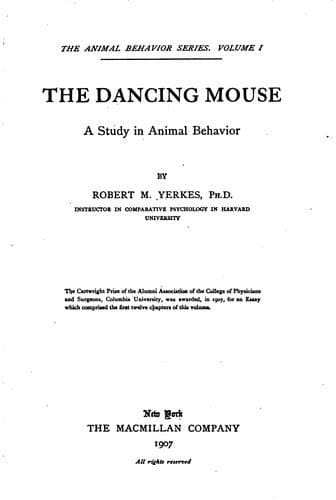
The Dancing Mouse: A Study in Animal BehaviorYerkes, Robert Mearns
Science
The Dancing Mouse: A Study in Animal Behavior
Yerkes, Robert Mearns
Animal behavior; Dancing mice
For this purpose I carefully selected five pairs of dancers of the same
age, descent, and previous experience, and gave them white-black tests in
series of two tests per day (after the twentieth day the number was
increased to five) until they had acquired a perfect habit of
discriminating. Similarly other dancers were trained by means of series of
ten tests, twenty tests, or one hundred tests per day. Since it was my aim
to make the results of these various tests strictly comparable, I spared
no pains in selecting the individuals, and in maintaining constancy of
experimental conditions. The order of the changes in the position of the
cardboards which was adhered to in these efficiency tests was that given
in Table 12.
At the beginning of the two-test training I thought it possible that the
animals might acquire a perfect habit with only a few more days' training
than is required by the ten-test method. This did not prove to be the
case, for at the end of the twentieth day (after forty tests in all) the
average number of mistakes, as Table 42 shows, was 3.2 for the males and
3.0 for the females. Up to this time there had been clear evidence of the
formation of a habit of discriminating white from black, but, on the other
hand, the method had proved very unsatisfactory because the first test
each day usually appeared to be of very different value from the second.
On account of the imminent danger of the interruption of the experiment by
the rapid spread of an epidemic among my mice, I decided to increase the
number of tests in each series to five in order to complete the experiment
if possible before the disease could destroy the animals. On the twenty-
first day and thereafter, five-test series were given instead of two-test.
Unfortunately I was able to complete the experiment up to the point of
thirty successive correct tests with only six of the ten individuals whose
numbers appear at the top of Table 42. That the results of this table are
reliable, despite the fact that some of the individuals had to be taken
out of the experiment on account of bad condition, is indicated by the
fact that all the mice continued to do their best to discriminate so long
as they were used. Possibly the habit would have been acquired a little
more quickly by some of the individuals had they been stronger and more
active.
Public-domain text, read in full here on John Shaqi.
Reviews
Reviews
No reviews yet
Be the first to share your thoughts on this work.
Elsewhere in the archive
Join the Discussion
Join the discussion
Sign in to leave a comment or review.
Sign InorCreate an account