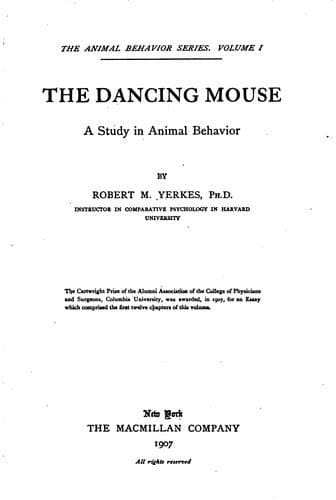
The Dancing Mouse: A Study in Animal BehaviorYerkes, Robert Mearns
Science
The Dancing Mouse: A Study in Animal Behavior
Yerkes, Robert Mearns
Animal behavior; Dancing mice
CONDITION MALES FEMALES
INDEX OF MODIFIABILITY INDEX OF MODIFIABILITY
2 or 5 tests per day 85.0 80.0
10 tests per day 72.0 104.0
20 tests per day 94.0 88.0
100 or more tests per day 160.0 180.0
From all considerations that have been mentioned thus far the reader would
be justified in concluding that I made a mistake in selecting the ten-test
method for my study of the modifiability of the behavior of the dancer.
That this conclusion is not correct is due to the time factor in the
experiments. If the dancer could acquire a perfect habit as a result of
twelve days' training, no matter whether two, five, ten, or twenty tests
were given daily, it would, of course, be economical of time for the
experimenter to employ the two-test method. But if, on the contrary, the
two-test method required twice as many days' training as the five-test
method, it would be economical for him to use the five-test method despite
the fact that he would have to give a larger number of tests than the two-
test method would have demanded. In a word, the time which the work
requires depends upon the number of series which have to be given, as well
as upon the number of tests in each series. As it happens, the ten-test
method demands less of the experimenter's time than do methods with fewer
tests per day. The twenty-test method is even more economical of time, but
it has a fatal defect. It is at times too tiresome for both mouse and man.
These facts indicate that a balance should be struck between number of
tests and number of series. The fewer the tests per day, within the limits
of two and one hundred, the higher the efficiency of the method of
training, as measured in terms of the total number of tests necessary for
the establishment of a perfect habit, and the lower its efficiency as
measured in terms of the number of series given. The greater the number of
tests per day, on the other hand, the higher the efficiency of the method
in terms of the number of series, and the lower its efficiency in terms of
the total number of tests. By taking into account these facts, together
with the fact of fatigue, we are led to the conclusion that ten tests per
day is the most satisfactory number.
Public-domain text, read in full here on John Shaqi.
Reviews
Reviews
No reviews yet
Be the first to share your thoughts on this work.
Elsewhere in the archive
Join the Discussion
Join the discussion
Sign in to leave a comment or review.
Sign InorCreate an account