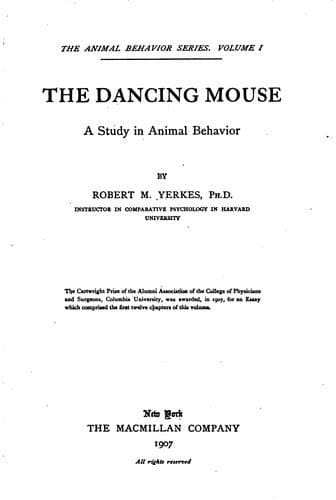
The Dancing Mouse: A Study in Animal BehaviorYerkes, Robert Mearns
Science
The Dancing Mouse: A Study in Animal Behavior
Yerkes, Robert Mearns
Animal behavior; Dancing mice
If my time and attention had not been fully occupied with other problems,
I should have determined the efficiency of various methods of training in
terms of the duration of habit, as well as in terms of the rapidity of its
formation. As these two measures of efficiency might give contradictory
results, it is obvious that a training method cannot be fairly evaluated
without consideration of both the rapidity of habit formation and the
permanency of the habit. A _priori_ it seems not improbable that slowness
of learning should be directly correlated with a high degree of
permanency. By the further application of the method which I have used in
this study of the efficiency of training we may hope to get a definite
answer to this and many other questions concerning the nature of the
educative process and the conditions which influence it.
CHAPTER XVI
THE DURATION OF HABITS: MEMORY AND RE-LEARNING
The effects of training gradually disappear. Habits wane with disuse. In
the dancer, it is not possible to establish with certainty the existence
of memory in the introspective psychological sense; but it is possible to
measure the efficiency of the training to which the animal is subjected,
and the degree of permanency of habits. The materials which constitute
this chapter concern the persistence of unused habits, and the influence
of previous training on the re-acquisition of a habit which has been lost
or on the acquisition of a new habit. For convenience of description, I
shall refer to certain of the facts which are to be discussed as facts of
memory, with the clear understanding that consciousness is not necessarily
implied. By memory, wherever it occurs in this book, I mean the ability of
the dancer to retain the power of adaptive action which it has acquired
through training.
I first discovered memory in the dancer, although there was previously no
reason for doubting its existence, in connection with the ladder-climbing
tests of Chapter XII. In this experiment two individuals which had
perfectly learned to escape from the experiment box to the nest-box by way
of the wire ladder, when tested after an interval of two weeks, during
which they had remained in the nest-box without opportunity to exercise
their newly acquired habit, demonstrated their memory of the method of
escape by returning to the nest-box by way of the ladder as soon as they
were given opportunity to do so. As it did not lend itself readily to
quantitative study, no attempts were made to measure the duration of this
particular habit. At best the climbing of a wire ladder is of very
uncertain value as an indication of the influence of training.
Similarly, the persistence of habits has been forced upon my attention day
after day in my various experiments with the mice. It is obvious, then,
that the simple fact of memory is well established, and that we may turn
at once to an examination of the facts revealed by special memory and re-
learning experiments.
Public-domain text, read in full here on John Shaqi.
Reviews
Reviews
No reviews yet
Be the first to share your thoughts on this work.
Elsewhere in the archive
Join the Discussion
Join the discussion
Sign in to leave a comment or review.
Sign InorCreate an account