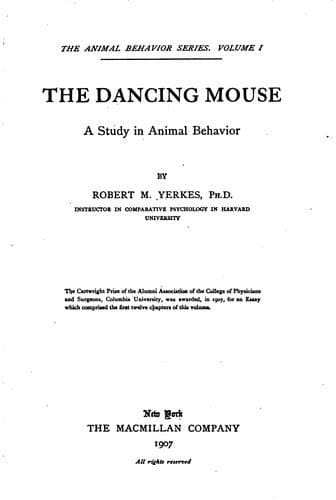
The Dancing Mouse: A Study in Animal BehaviorYerkes, Robert Mearns
Science
The Dancing Mouse: A Study in Animal Behavior
Yerkes, Robert Mearns
Animal behavior; Dancing mice
The visual discrimination method, which proved invaluable as a means of
measuring the rapidity of habit formation, proved equally serviceable in
the measurement of the permanency or duration of habits. Memory tests for
discrimination habits were made as follows. After a dancer had been
trained in the discrimination box so that it could choose the correct
electric-box, white, red, blue, or green as it might be, in three
successive daily series of ten tests each, it was permitted to remain for
a certain length of time without training and without opportunity to
exercise its habit of visual discrimination and choice. At the expiration
of the rest interval, as we may designate the period during which the
habit was not in use, the mouse was placed in the discrimination box under
precisely the same conditions in which it had been trained and was given a
series of ten memory tests with the box to be chosen alternately on the
right and on the left. In order that the entire series of ten tests, and
sometimes two such series given on consecutive days, might be available as
indications of the duration of a habit, the mouse was permitted to enter
and pass through either of the electric-boxes without receiving a shock.
Had the shock been given as punishment for a wrong choice, it is obvious
that only the first test of the memory series would be of value as an
indication of the existence of a previously acquired habit. Even under the
conditions of no shock and no stop or hindrance the first test of each
memory series is of preeminent importance, for the mouse tends to persist
in choosing either the side or the visual condition (sometimes one,
sometimes the other) which it chooses in the first test. If the wrong box
is chosen to begin with, mistakes are likely to continue because of the
lack of punishment; in this case the animal discriminates, but there is no
evidence that it remembers the right box. Likewise, if the right electric-
box is chosen in the first test, correct choices may continue simply
because the animal has discovered that it can safely enter that particular
box; again, the animal discriminates without depending necessarily upon
its earlier experience. I have occasionally observed a series of ten
correct choices, made on the basis of an accidental right start, followed
by another series in which almost every choice was wrong, because the
animal happened to start wrong.
As the results of my tests of memory are of such a nature that they cannot
advantageously be averaged, I have arranged in Table 48 a number of
typical measurements of the duration of visual discrimination habits. In
this table I have indicated the number and age of the individual tested,
the habit of discrimination which had been acquired, the length of the
rest interval, the result of the first test (right or wrong), and the
number of errors made in each series of ten memory tests.
TABLE 48
MEASUREMENTS OF THE DURATION OF A HABIT
Memory
Public-domain text, read in full here on John Shaqi.
Reviews
Reviews
No reviews yet
Be the first to share your thoughts on this work.
Elsewhere in the archive
Join the Discussion
Join the discussion
Sign in to leave a comment or review.
Sign InorCreate an account