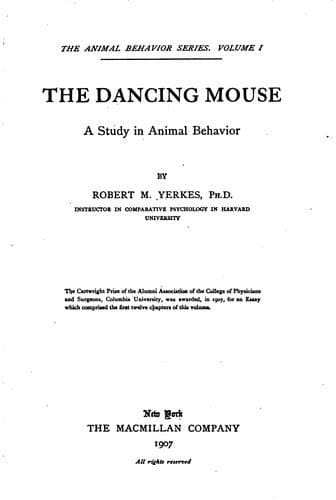
The Dancing Mouse: A Study in Animal BehaviorYerkes, Robert Mearns
Science
The Dancing Mouse: A Study in Animal Behavior
Yerkes, Robert Mearns
Animal behavior; Dancing mice
The behavior of the mice in the experiments, the detailed results of
Tables 49 and 50, and the indices of modifiability together justify the
following conclusions. Most of the ten dancers, at the end of a rest
interval of eight weeks, had so far lost the habit of white-black
discrimination that memory tests furnished no conclusive evidence of the
influence of previous training; a few individuals seemed to possess traces
of the habit after such an interval. In the case of each group of
individuals re-training brought about the establishment of a perfect habit
far more quickly than did the original training. This suggests the
existence of two kinds or aspects of organic modification in connection
with training; those which constitute the basis of a definite form of
motor activity, and those which constitute the bases or dispositions for
the acquirement of certain types of behavior. There are several
indications that further study of the modifiability of behavior will
furnish the facts which are necessary to render this suggestion
meaningful.
Closely related to the facts which have been revealed by the re-training
experiments are certain results of the labyrinth experiments. For the
student of animal behavior, as for the human educator, it is of importance
to learn whether one kind of training increases the efficiency of similar
forms of training. Can a dancer learn a given labyrinth path the more
readily because it has previously had experience in another form of
labyrinth?
The answer to this question, which my experimental results furnish, is
given in Table 51. In the upper half of the table have been arranged the
results for six individuals which were trained first in labyrinth B, then
in labyrinth C, and finally in labyrinth D. Below, in similar fashion, are
given the results for six individuals which were trained in the same three
labyrinths in the order C, B, D, instead of B, C, D. My purpose in giving
the training in these two orders was to ascertain whether labyrinth C,
which had proved to be rather difficult for most individuals, would be
more easily learned if the training in it were preceded by training in
labyrinth C.
TABLE 51
THE INFLUENCE OF ONE LABYRINTH HABIT UPON THE FORMATION
OF ANOTHER
LABYRINTH B LABYRINTH C LABYRINTH D
NO. OF NO. OF NO. OF NO. OF NO. OF NO. OF
NO. FIRST COR- LAST OF FIRST COR- LAST OF FIRST COR- LAST OF
RECT TEST FIVE COR- RECT TEST FIVE COR- RECT TEST FIVE COR-
RECT TESTS RECT TESTS RECT TESTS
Public-domain text, read in full here on John Shaqi.
Reviews
Reviews
No reviews yet
Be the first to share your thoughts on this work.
Elsewhere in the archive
Join the Discussion
Join the discussion
Sign in to leave a comment or review.
Sign InorCreate an account