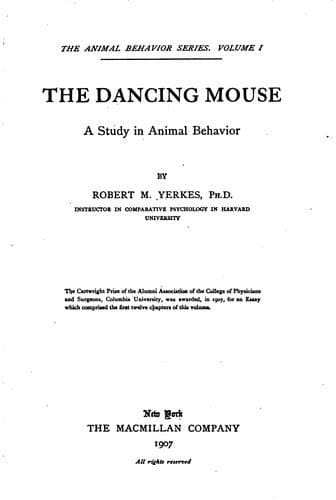
The Dancing Mouse: A Study in Animal BehaviorYerkes, Robert Mearns
Science
The Dancing Mouse: A Study in Animal Behavior
Yerkes, Robert Mearns
Animal behavior; Dancing mice
76 8 14 3 19 4 7
78 5 20 6 14 4 5
86 13 22 5 12 3 9
75 4 15 8 19 4 13
77 7 11 11 29 11 12
87 12 22 9 20 4 9
AV. 8.2 17.3 7.0 18.8 5.0 9.2
LABYRINTH C LABYRINTH B LABYRINTH D
58 16 -- 2 14 7 10
60 17 -- 13 37 10 14
88 25 35 9 22 4 8
49 34 -- 1 5 7 8
57 15 -- 3 20 3 6
85 11 18 2 11 3 4
AV. 19.7 26.5 5.0 18.2 5.7 8.3
The results are sufficiently definite to warrant the conclusion that
experience in B rendered the learning of C easier than it would have been
had there been no previous labyrinth training. Those individuals whose
first labyrinth training was in C made their first correct trip as the
result of 19.7 trials, whereas those which had previously been trained in
labyrinth B were able to make a correct trip as the result of only 7.0
trials. Similarly the table shows that training in C rendered the
subsequent learning of B easier. To master B when it was the first
labyrinth required 8.2 trials; to master it after C had been learned
required only 5 trials. In addition to proving that the acquisition of one
form of labyrinth habit may facilitate the acquisition of others,
comparison of the averages of Table 51 furnishes evidence of the truth of
the statement that no results of training can be properly interpreted in
the absence of knowledge of the previous experience of the organism.
CHAPTER XVII
INDIVIDUAL, AGE, AND SEX DIFFERENCES IN BEHAVIOR
All dancers are alike in certain important respects, but to the trained
observer of animal behavior their individual peculiarities are quite as
evident, and even more interesting than their points of resemblance.
Omitting consideration of the structural marks of individuality, we shall
examine the individual, age, and sex differences in general behavior,
rapidity of learning, memory, and discrimination, which have been revealed
by my experiments. Observations which bear on the subject of differences
are scattered through the preceding chapters, but in no case have they
been given sufficient prominence to force them upon the attention of those
who are not especially interested in individual peculiarities. It has
seemed worth while, therefore, to assemble all the available material in
this chapter for systematic examination and interpretation.
Public-domain text, read in full here on John Shaqi.
Reviews
Reviews
No reviews yet
Be the first to share your thoughts on this work.
Elsewhere in the archive
Join the Discussion
Join the discussion
Sign in to leave a comment or review.
Sign InorCreate an account