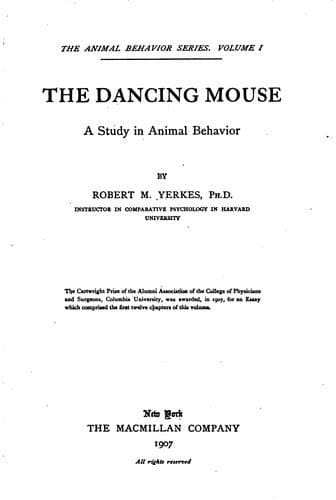
The Dancing Mouse: A Study in Animal BehaviorYerkes, Robert Mearns
Science
The Dancing Mouse: A Study in Animal Behavior
Yerkes, Robert Mearns
Animal behavior; Dancing mice
Differences in docility which are obviously to be correlated with age
abound. In the prime of its life (from the second to the tenth month) the
dancer is active, full of energy, quick to learn; in its senility (during
the second year) it is inactive, but at times even more docile than during
the period of greatest physical development. Frequently I have noticed in
connection with labyrinth tests that individuals of the age of a year or
more learn much more quickly than do individuals of the age of two or
three months. But, on the other hand, I have contradictory observations,
for now and then I obtained just the opposite result in experiments to
test docility. Evidently this is a matter which demands systematic,
quantitative investigation. Casual observation may suggest conclusions,
but it will not justify them.
Early in my investigation of the behavior of the dancer I conceived the
idea of determining the relation of modifiability of behavior (docility)
to age. The question which was foremost in my mind and for which I first
sought an answer may be stated thus: can the dancer acquire a given habit
with the same facility at different ages? Since the visual discrimination
experiment seemed to be well suited for the investigation of this problem
I planned to train, in the white-black discrimination experiment, five
pairs of dancers at the age of one month, and the same number for each of
the ages four, seven, ten, thirteen, sixteen, and nineteen months.[1]
[Footnote 1: I have not been able thus far to determine the average length
of the dancer's life. The greatest age to which any of my individuals has
attained is nineteen months.]
To test the same individuals month after month would be the ideal way of
obtaining an answer to our question, but I could devise no satisfactory
way of doing this. The effects of training last so long, as the results of
the previous chapter proved, and the uncertainty of their entire
disappearance is so serious, that the same training process cannot be used
at successive ages. The use of different methods of training is even more
unsatisfactory because it is extremely difficult to make accurate
quantitative comparison of their results. It was these considerations that
forced me to attempt to discover the relation of docility to age by
carrying out the same experiments with groups of individuals of different
ages.
Public-domain text, read in full here on John Shaqi.
Reviews
Reviews
No reviews yet
Be the first to share your thoughts on this work.
Elsewhere in the archive
Join the Discussion
Join the discussion
Sign in to leave a comment or review.
Sign InorCreate an account