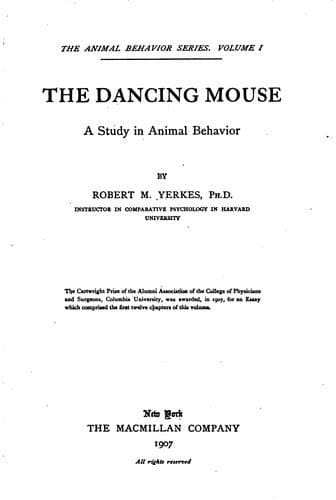
The Dancing Mouse: A Study in Animal BehaviorYerkes, Robert Mearns
Science
The Dancing Mouse: A Study in Animal Behavior
Yerkes, Robert Mearns
Animal behavior; Dancing mice
Another indication of individual initiative in action appeared in the
tendency of certain mice to climb out of the experiment boxes or
labyrinths. It would have been extremely easy for any of the mice to
escape from the labyrinths by scaling the walls of the alleys, for they
were only 10 cm. in height, and when a dancer stood on its hind legs it
could easily reach the top with its nose. But, strange though it will seem
to any one who has not worked with the dancer, not more than one in ten of
the animals which I observed made any attempt to escape in this manner.
They lacked initiative. That it was not due to a lack of the power to
climb, I abundantly demonstrated by teaching a few individuals that a
scramble in one corner meant easy escape from the maze of paths. I do not
think any one of the mice was physically incapable of climbing, but I am
confident that they differed markedly, not only in the willingness to try
new modes of action, but in the readiness with which they could climb. I
have already said that individuals differ noticeably in the scope of their
activity. By this statement I mean that they try a varying number of kinds
of activity. As in the case of men, so in mice, one individual will do a
greater number of things in a few hours than another will in weeks or
months. The dancers differ in versatility, in individual initiative, as do
we, albeit not so markedly.
Important differences which may with certainty be described as age
differences are not so obvious as are such marks of individuality as have
been set forth in the preceding pages. I have noted few changes in
discriminative sensitiveness, other than those with regard to auditory
sensitiveness, which could be correlated with age. In certain instances
adults appeared to be able to discriminate more accurately and more easily
than young mice, but it is difficult to say whether this change belongs
under sensitiveness or docility. I have not made an ontogenetic study of
the senses, and I am therefore unable to describe in detail the course of
their development and decline. Of one important fact I am certain, that
discriminative sensitiveness increases up to a certain point with age and
with training.
Public-domain text, read in full here on John Shaqi.
Reviews
Reviews
No reviews yet
Be the first to share your thoughts on this work.
Elsewhere in the archive
Join the Discussion
Join the discussion
Sign in to leave a comment or review.
Sign InorCreate an account